Richardson Collection
THE RICHARDSON COLLECTION
David Richardson is a collector who has decided to focus - on Babies. This enables him to keep space requirements under control (some hope in my case!) and to develop much greater depth of knowledge and detail than the more flibbertigibbet butterflies such as me. If they could find anyone to do the questions, he could go on Masternerd. He occasionally has a slight fall from grace, (see Toys) but overall seems to have remarkable willpower. He has now sent me so many pix I thought he deserved a page of his own.
We start with a guide to spotting the Model A. Stuff in quotes is from Dave himself.
"I thought for anybody that may be interested I would point out the main points of a Model A Pathé Baby as people get confused.
The main identifying points are as follows:-
Smaller Mirror compared to next Model ( Picture 1),
Smaller projection nozzle ( Picture 2)
Lamp house reflector comes off complete with bulb holder and wiring (Picture 3).
Next Model - only reflector comes off (Picture 4)"


Next, some splendid pix of Babies with unusual attachments, for which many thanks - these are superb.


Reading from left to right, we have the Enlarger attachment for making frame blow-ups, a continuous projection attachment, a French patent lamphouse of unknown manufacture and a French-style machine with Souplex super attachments and motor.


Here we have the not-wholly-unknown rear-mounted dynamo, and one I've never heard of, a side-mounted dynamo with its own special mat. Next is a close-up of the Souplex motor and its friction brake and last, a front-mounted "R" motor, fitted with the optional flywheel for smoother running and its own special resistor, which I'd also never heard of. David promises more pix, too.
And here they are:-
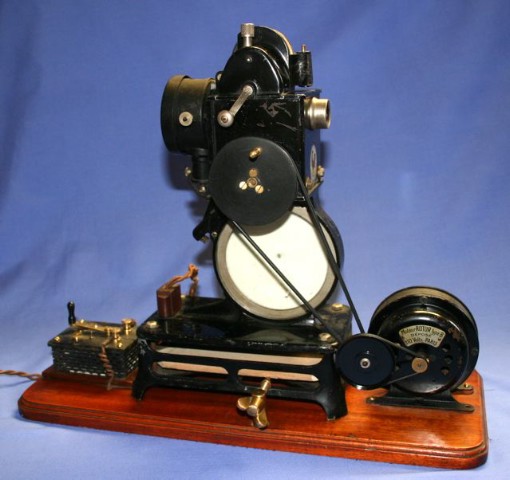
This is a Model A Baby fitted to a wooden base, with the Rotor type B motor fitted in front of the projector.


This is a Model A Fitted on a board with Rotor type B motor, but rear-mounted. David believes this was a later model, but both by the same manufacturer as the fittings are identical, and that the changed position of the motor was to allow for the fitting of Super arms. The "before" pic above shows just how good David is at this restoration business. The black resistance adjusts motor speed, the other control is to switch on the room light after projection. David says:-
"In the early days, if you were lucky enough to have electricity, each room would probably only have one ceiling light, which was used for plugging in both a light bulb and any other electrical gizmo you had, in this case a Pathé Baby projector. The problem being that, after projecting a film, one had to fumble about in dim light maybe from the hall light and, after finding the hall door and falling over the cat, unplug the projector and plug the light bulb back in. This problem was addressed by Pathé through the two-way switch "for conveniently lighting the room between projections; merely pressing the pear shaped switch changes over the illumination from the projector to the room lamp; another press and the lighting is reversed back to the projector lamp". The owner of the projector in these pictures has added his own home-made two-way switch; with the lever on the wooden box to centre, both lights are off; to the right, projector on, main light off, to the left, main light on, projector off. The base, motor, projector fixings and resistance I believe to be professionally made as I have seen one other the same."


These show a water-cooled condenser head. David again:-
"This has two nipples, as can be seen in the picture. I assume these are inlet and outlet and that they were connected to the mains water by rubber pipes. There is also a bleed screw at the top. I believe the lamp was 12 volt 60 watt. If anyone has any more infoon this head I would appreciate it." He has since found another, complete with the controller/transformer, giving 12,14 or 16 volt output for the lamp (pic 5).

And this is more stuff about the water-cooled condenser set-up. It seems to have been made by a company called Mollier, and come in two versions. First was a new lamphouse to give a brighter light from a new lamp and condenser lens, tho' the voltage and wattage of the lamp seem a bit unclear. The second or "Super" version had the water-cooled jacket. Partly because it's not always clear from my knowledge or not of technical French, and partly because all we have to work on is an extract from a French equivalent of a Wallace Heaton Blue Book, everything else is less than clear, too. The text seems to imply that there is an automatic voltage reduction for still frames, to prevent heat damage to the film. However, looking at the pic shows no way this could happen and Dave can't see how either, despite having got one of them. We shall have to find more info. Note the support bracket in the catalogue.


These show an amazing attachment with the Rotor type B motor and variable resistance as a single unit for easy fitting to any basic Pathé Baby.


Pathé Baby with unusual resistance listed in 1926 French catalogue.
Accessories


Pathé Baby fitted with redressing mirror, to throw pictures on screen at right angles (as listed in 1930 catalogue). The reversed pic might not have worried some, particularly if titles were few, but it was no doubt also used for back projection.


Model C Dynamo (as listed in Pathescope catalogues 1929-30); the main difference from Model D is that the model C has a plug-type output, as shown in the second pic. The model D has two screw-type outputs, as per 3rd pic. The Instructions are for a side-mounted dynamo.
Now some motor details. In order these are an early "B" type; the later "B" type; the 1922 "R" type; early "S" type from 1926; 1928 French "S" type; 1928 "S" type; 1929 "S"; the "C" type from 1930. The three pix on the second row show how the semi-automatic speed control worked; when the motor tried to speed up at a notch (mech stopped, therefore no load), the inner weights shown in the second of these pix would tend to fly out, so increasing braking force.


Some random motor instructions.


He has loads of bits for Babies, too:-


French version of two way switch (the switch is made out of a multicoloured bakelite material) and its pic from the 1926 Catalogue and an entry from Cinéma Chez Soi No. 90, then English version and 1938 Catalogue pic.


These are English variants of the two-way switch; the Catalogue is 1926, the pictures are the earlier and later types respectively.
The American market took a completely different approach to motorisingtheir Pathé Baby's, although they where still made in France. They were first introduced to America in December 1925, under the trade name of Pathex. (An editorial comment here. I have sometimes wondered quite why there seems to be so much Pathex material in the UK, most notably spools and some Baby bits. Did Pathé plan a huge sales push which fizzled, leaving them with huge stocks? I suppose there is an answer in Kermabon or whatever, but company history bores me - has anyone done the work?)


The first three are David's earliest American machine, a Model D with motor speed via a slider on the added resistance block. The next two are also a Model D projector, but with speed control by a potentiometer/resistance with rotary knob. The last three are close-ups to show detail of the motor mounting and the spring with which pressure of the motor roller on the shutter can be adjusted.
These pix below are a Model G machine, with a later motor version. Note that, altho' there is a slit in the side for the American motor, the decal on the side is Pathé.


Yet more bits.


The first two are the Pathescope Super condenser, alleged to allow more light thru, tho' I am not clear what is the physics behind this claim. I've cheated a bit on the blurb by mocking up an English-only version; I saw no reason to tidy up a load of foreign stuff to give you the whole thing. The third pic show an add-on version of the rack and pinion focussing, to replace the rather trickier lever mech of early machines.
Baby Enlarger Attachment
I've never see even a photo of one of these before, just adverts. Dave R has done a splendid job in showing exactly what it is and how it works. The idea is you put some photo-sensitive film in the big end, to copy whatever frame you have in the gate. Exposure must have been trial and error.


Baby Magnifier Attachment
This was supposed to approx double the size of the projected picture. What it must have done to the brightness, tho'.......


This apparently does the same job as the cone-shaped PathMagnifier lens. The third pic shows a Pathexor Krauss lens, one of two better-quality lenses available for the Baby, the fourth another, the Hermagis.


Another splendid series of pix from Dave Richardson, tho' I admit they are not projectors. There are some good pix of a motorised attachment for the Baby Camera under Gear.
Below are of miniature titling outfits designed to attach to the front of a Baby camera or a Motocamera, the latter having 2 different size kits. Not quite sure whether the last pic is the same thing as the others but, hey!


Why did anyone ever need anything else?