- Details
- Parent Category: 9.5mm silent
- Category: Baby Projector
BabyFilmcats
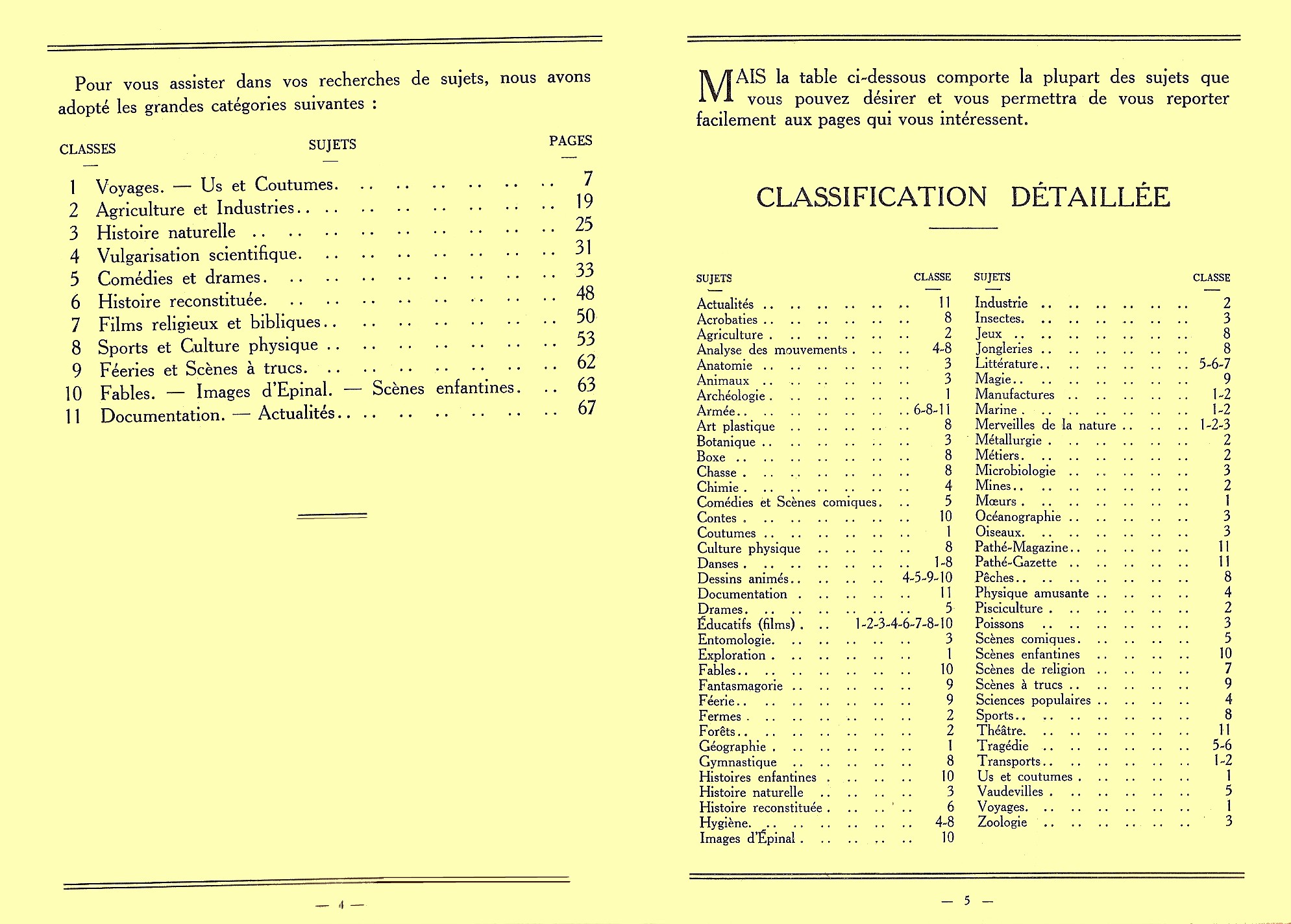
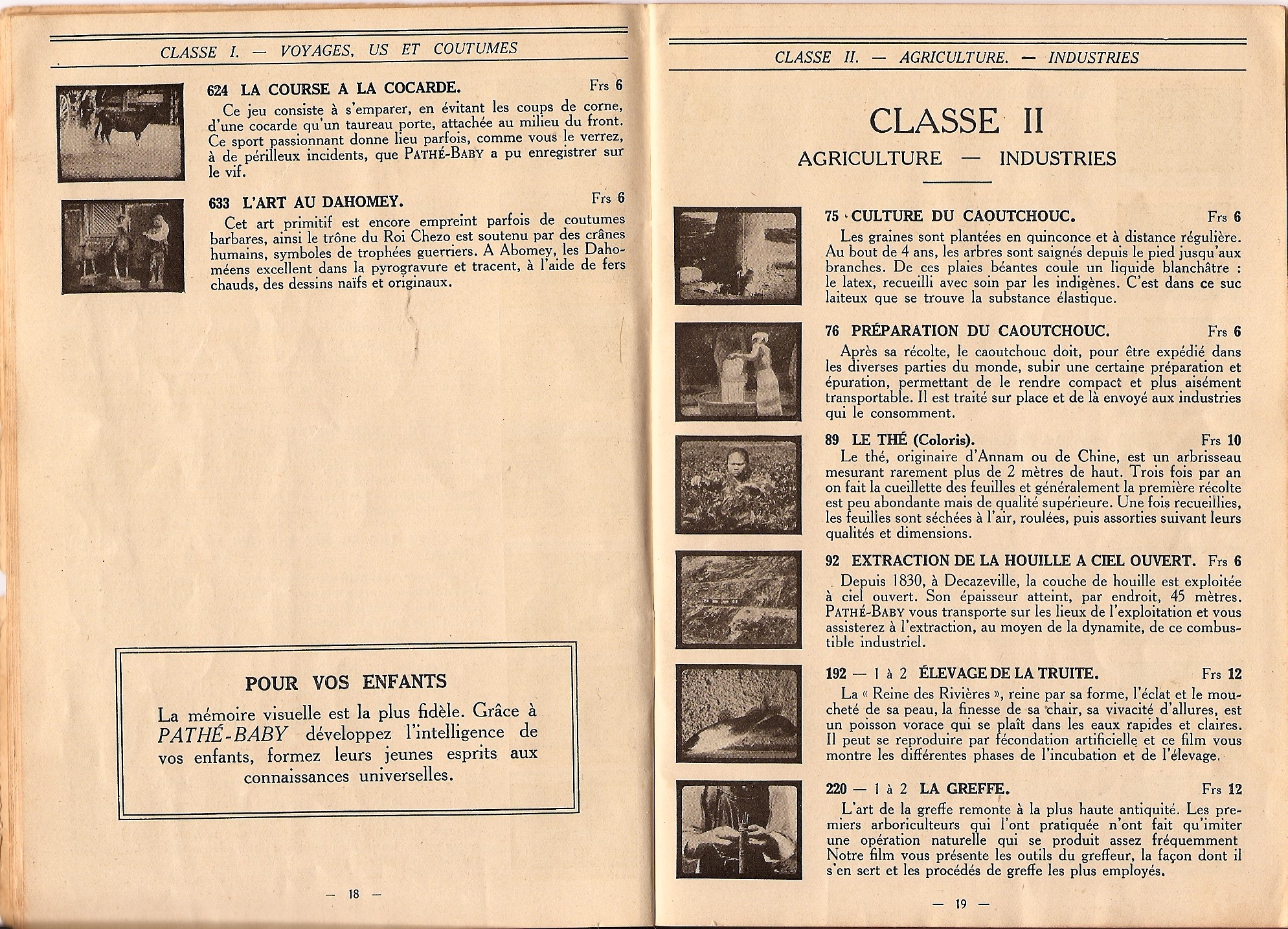
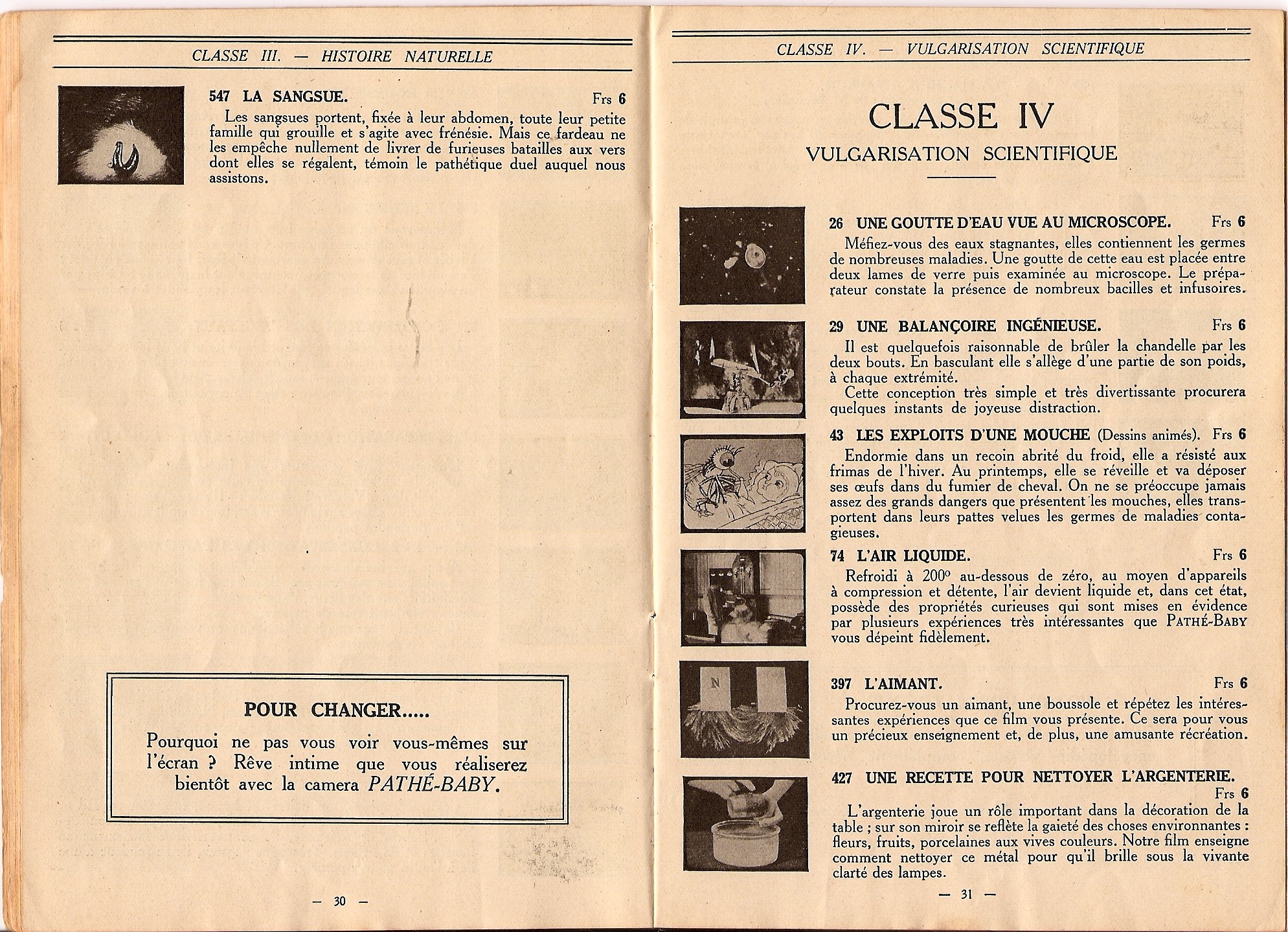
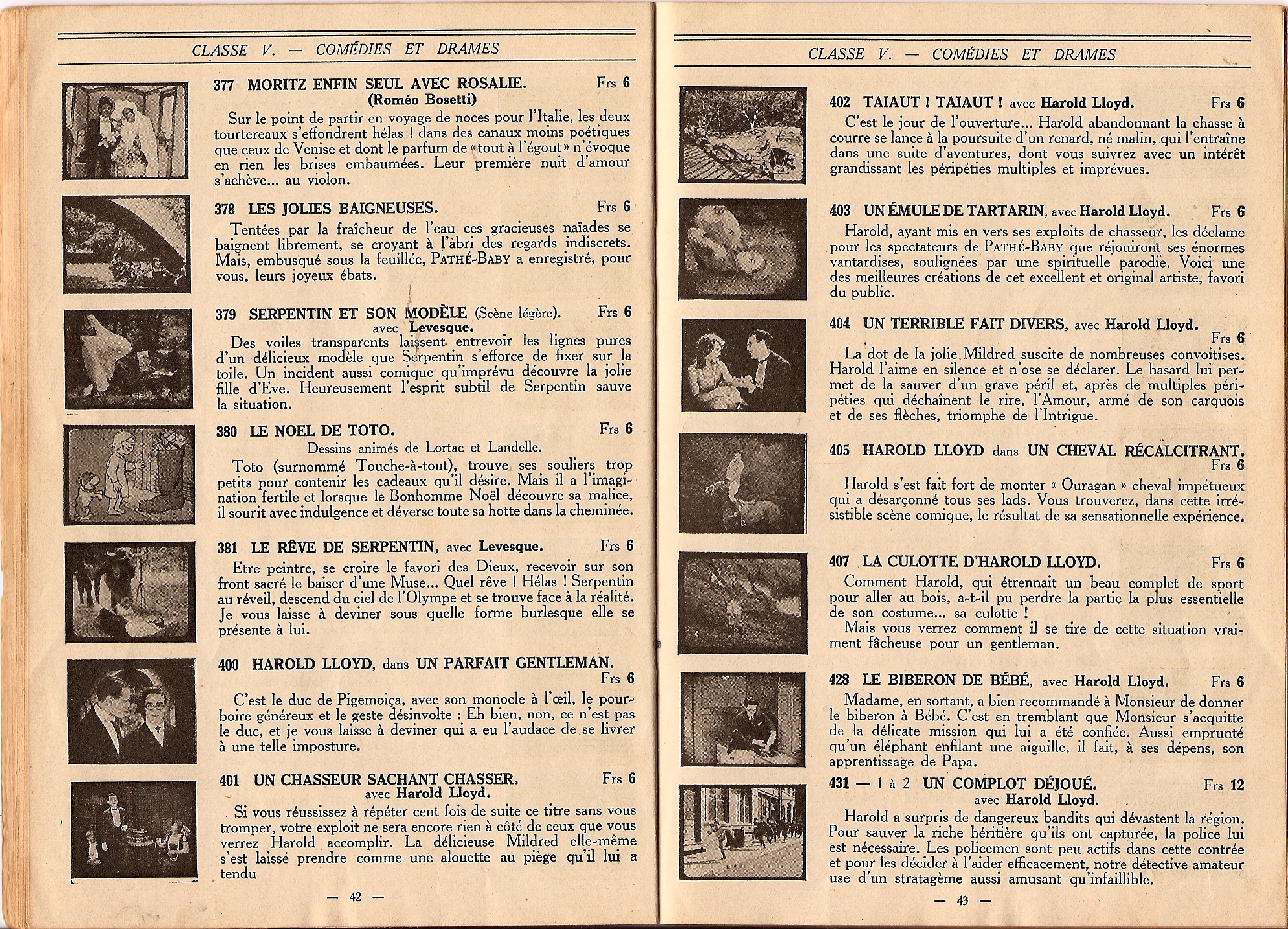
This says it is the first French descriptive catalogue and is dated October 1922. The individual pix did not survive the Great Software Disaster of 2014 so I am trying a PDF instead. I still have higher res scans in case.
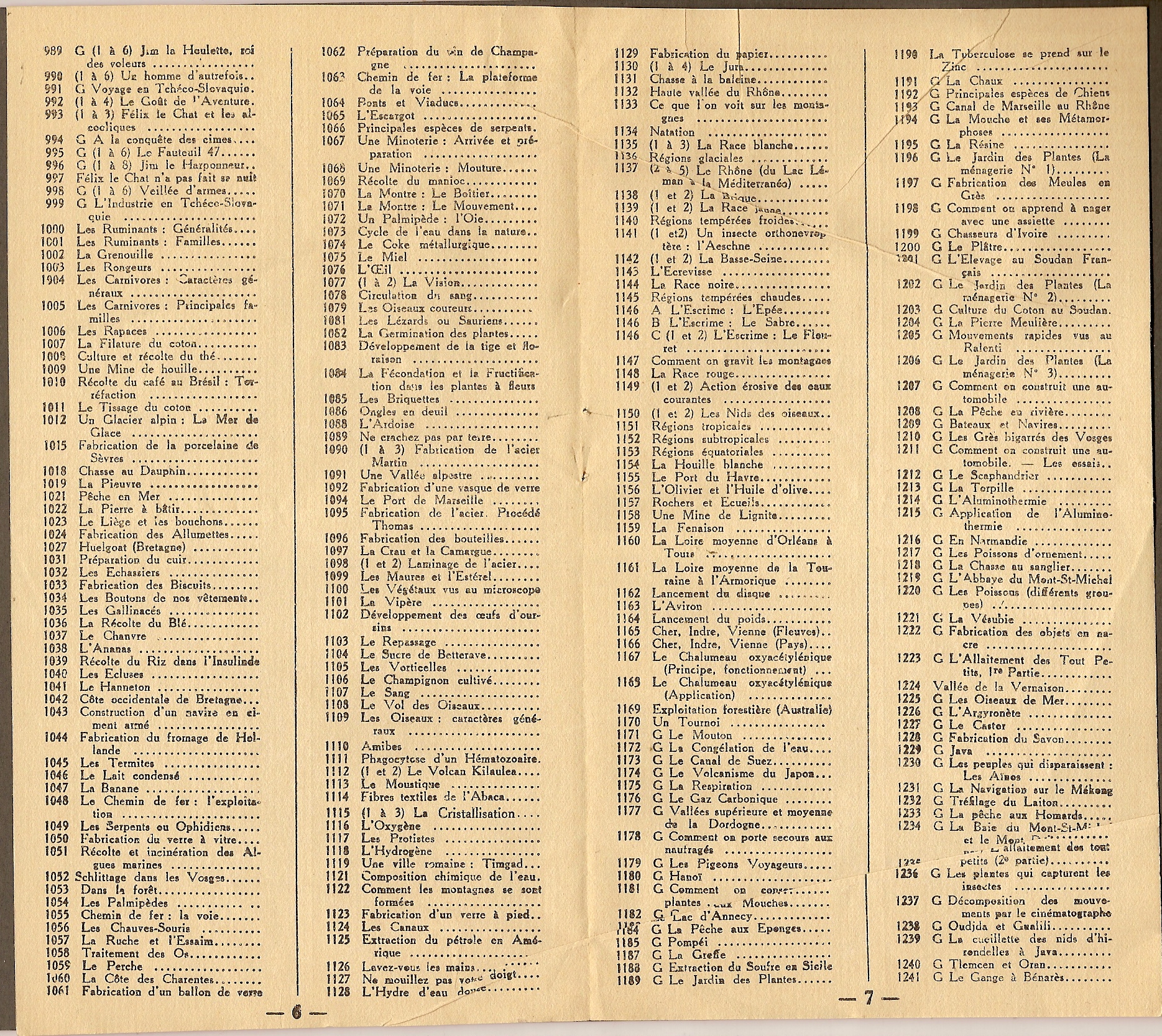
David Richardson has kindly scanned all sorts of useful, early literature, including the catalogue from 1923 below. I have some difficulty with how to present such documents, including the 1922 catalogue above. Inevitably, the scanning process is imperfect; the slightest lack of flatness and "stains" appear. Try to adjust the background colour to what it might once have been before the paper faded, and you leach away some of the very wide range of colours of which the letters are composed. To show you, I have given 3 versions of pages 6&7; the original scan, a pale yellow/cream colour that I have found works well, and a rather stark black and white version. Deciding just how much work to do is difficult - it doesn't help that I quite enjoy doing it and find it quite compulsive - because it can be very time-consuming and there is just so much material. I shall have to leave most of them unprocessed for now. At least, I shall end up making a virtual archive of information that anyone can access, whereas actual copies are very rare indeed. I am very grateful to people like Dave who are willing to share their material in this way. He has also provided more of the Baby film leaflets - these, too, are unprocessed - which I have started to add - see Before PM...










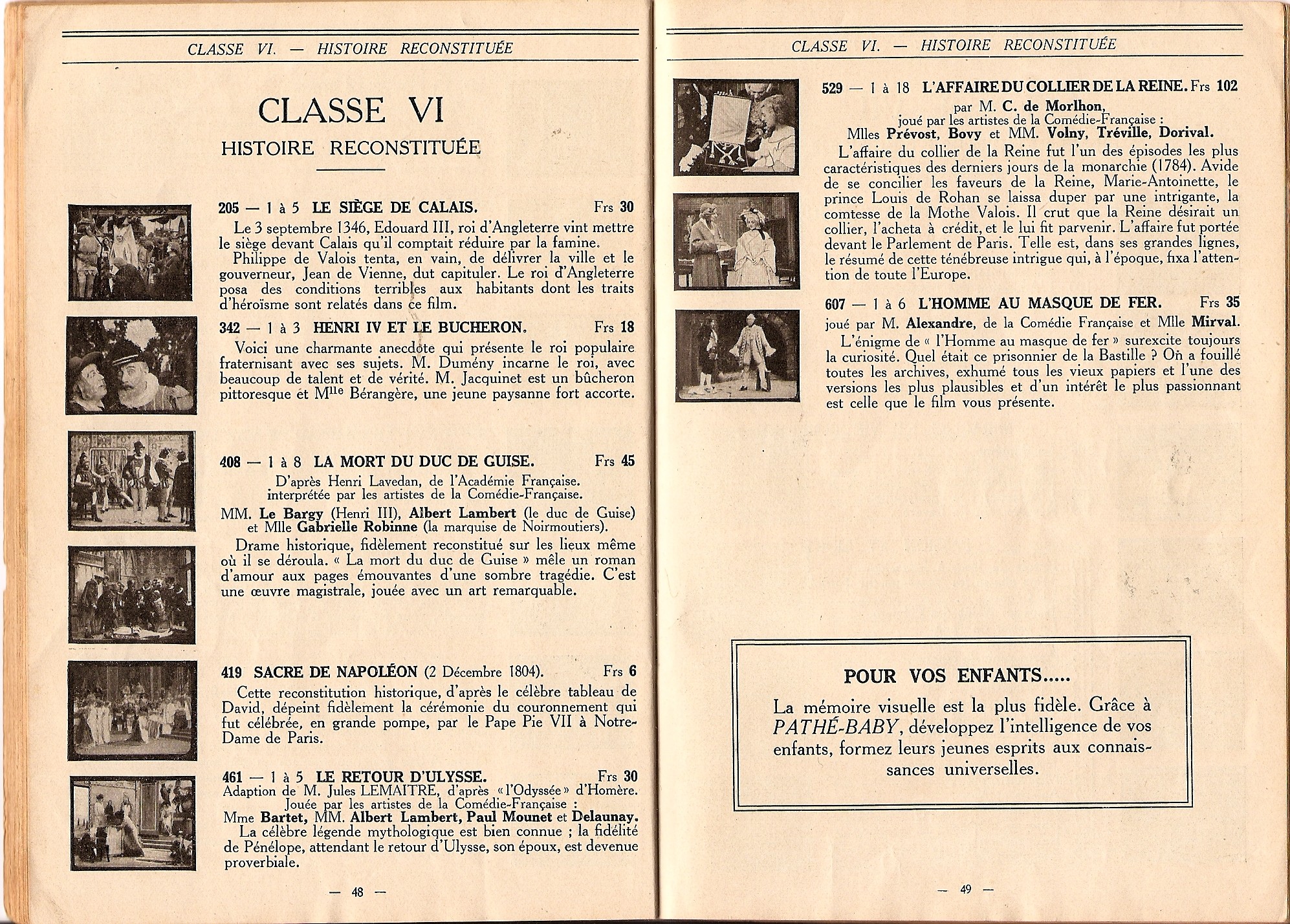


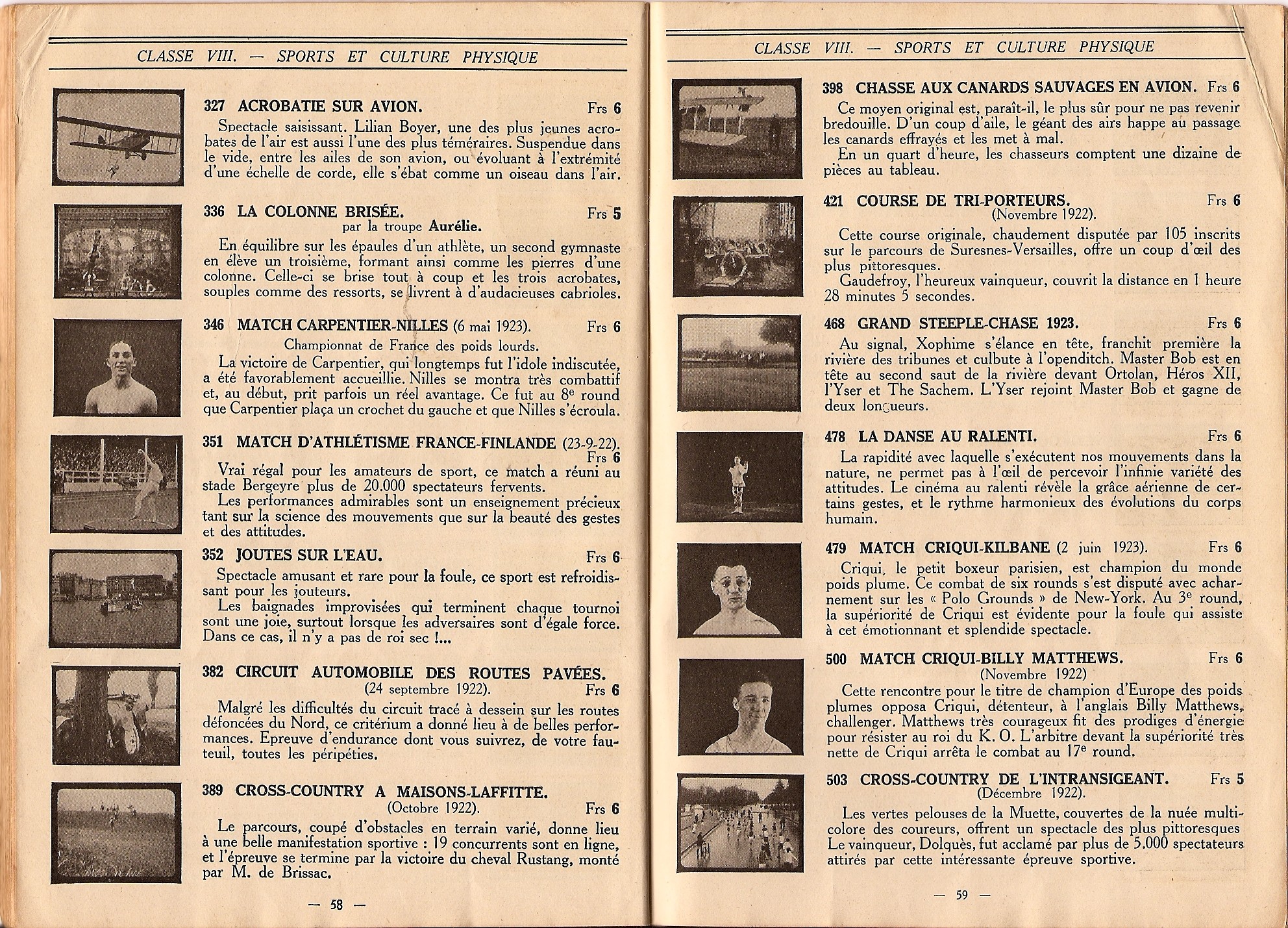
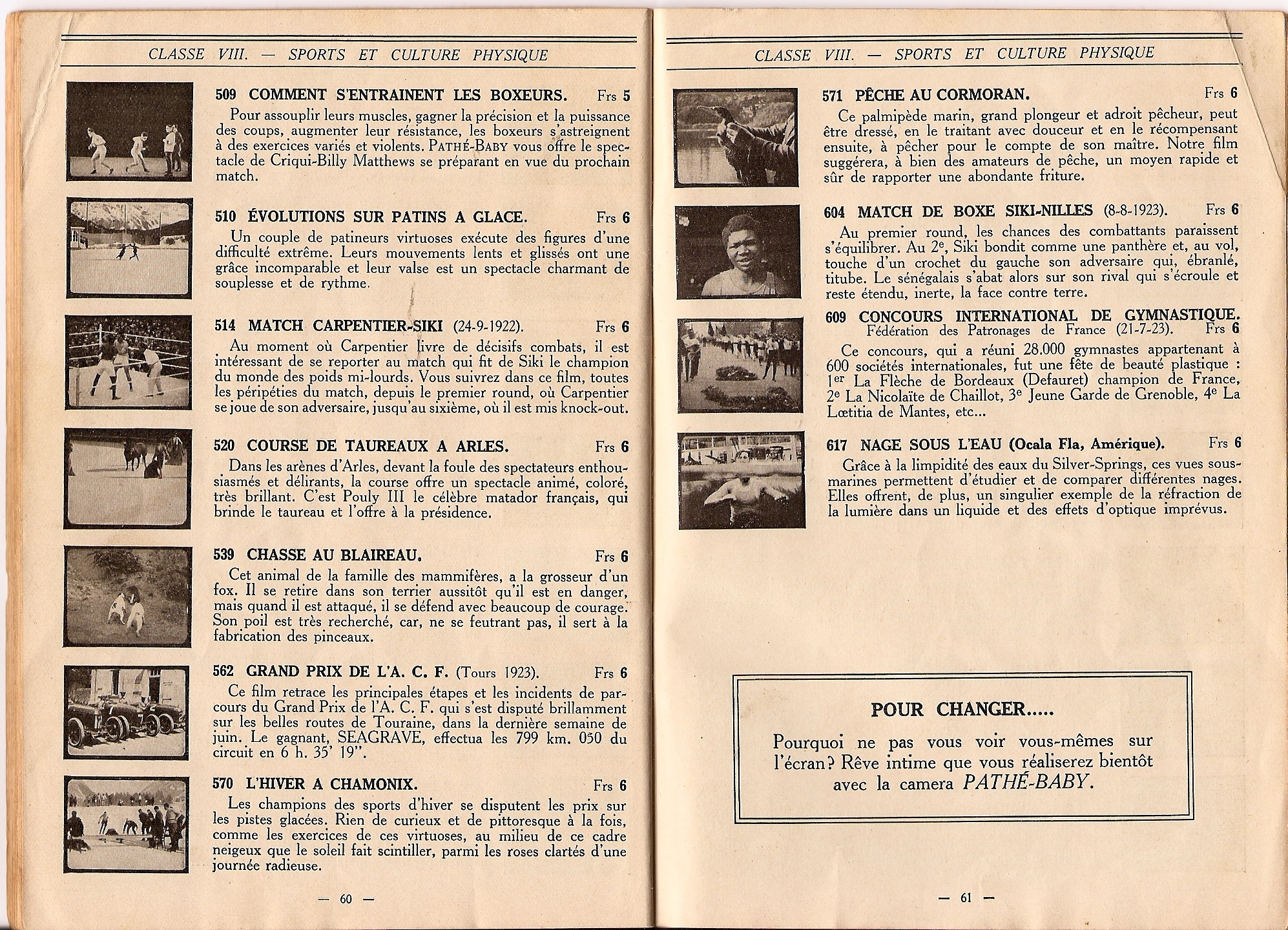


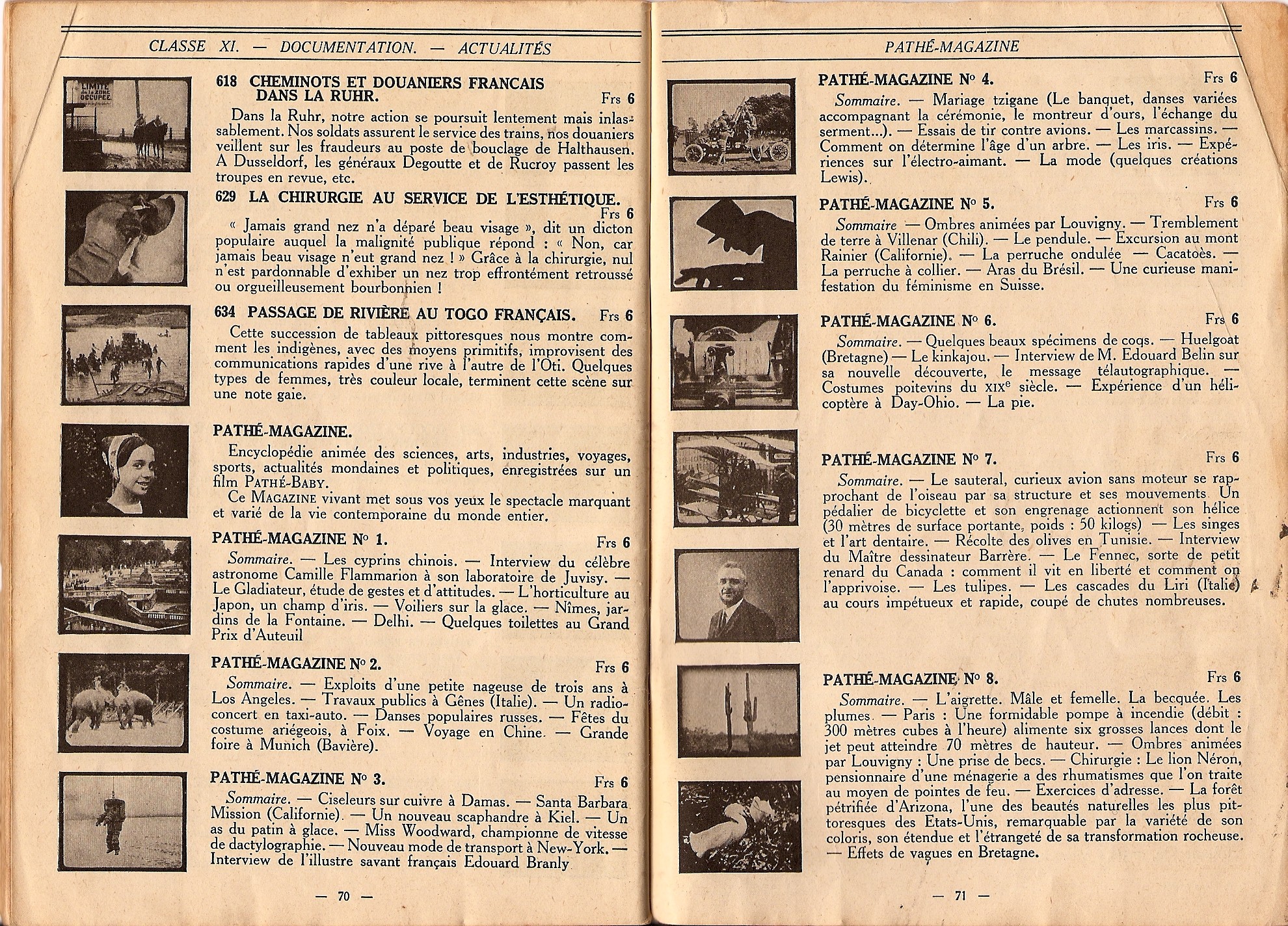


Update July 2010.Thanks to Dino Everett for this (presumably abbreviated) catlog, Xmas/New Year 1922/3, a four-pager, now added above. Dino points out that no film numbers are missing yet!End Update
SUPPLEMENTS
These Supplements presumably are additions to the French 1922 and 1923 catalogues above. Comparing the two catlogs,the rate of growth in a single year is very evident.
March 1923


This early supplement (above) shows yet another problem of trying to conserve these documents digitally. The originals are in fact printed on a very faint background of strips of 9.5 film with indiscernible images. It is beyond my capabilities to preserve this and I have simply painted it out. Several at least of the supplements below were printed in the same way. Update June 2014. It now seems my scanner was at fault; some more recent scans have come out quite well. End Update.
April 1923


June 1923


July 1923


April 1924
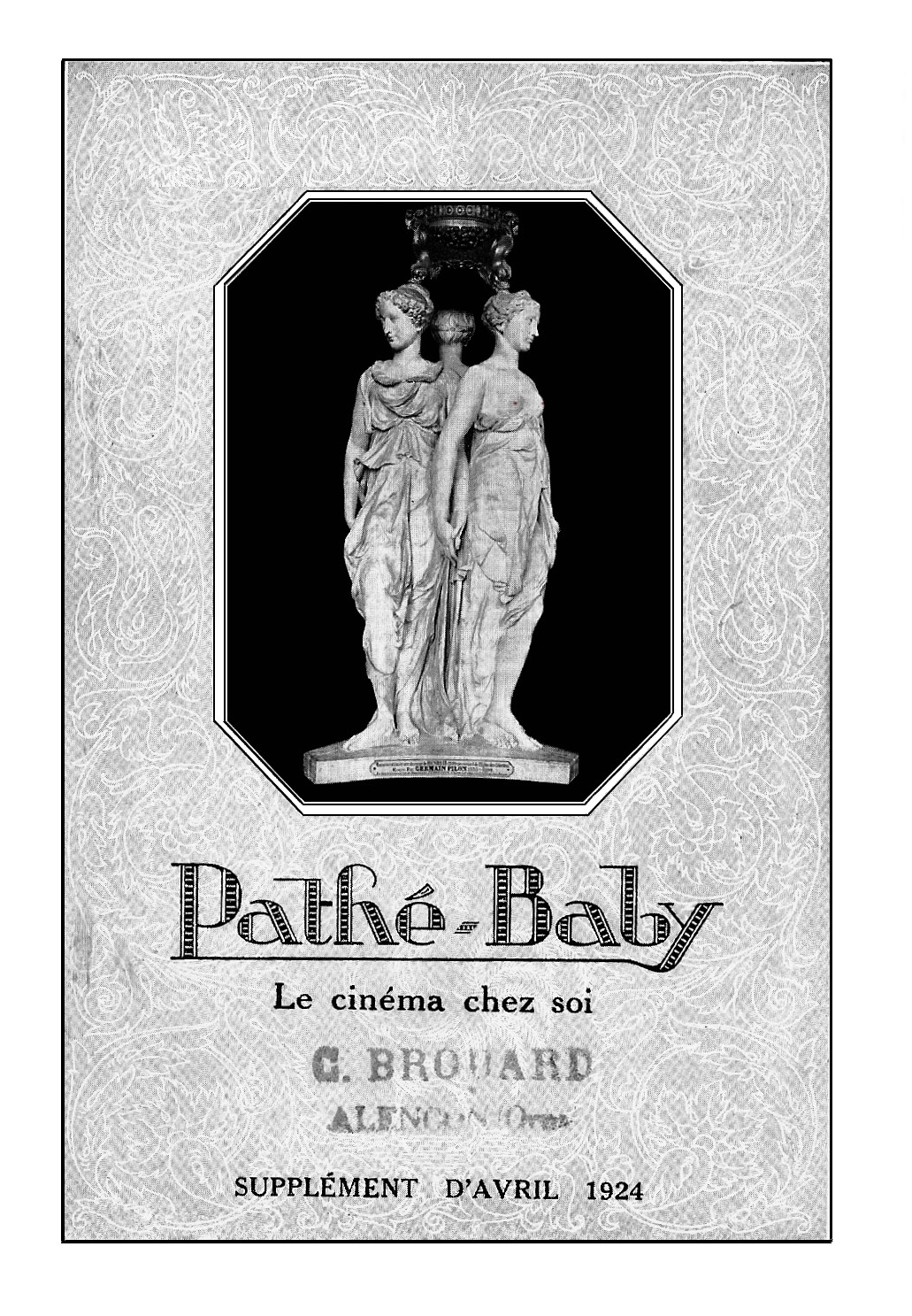
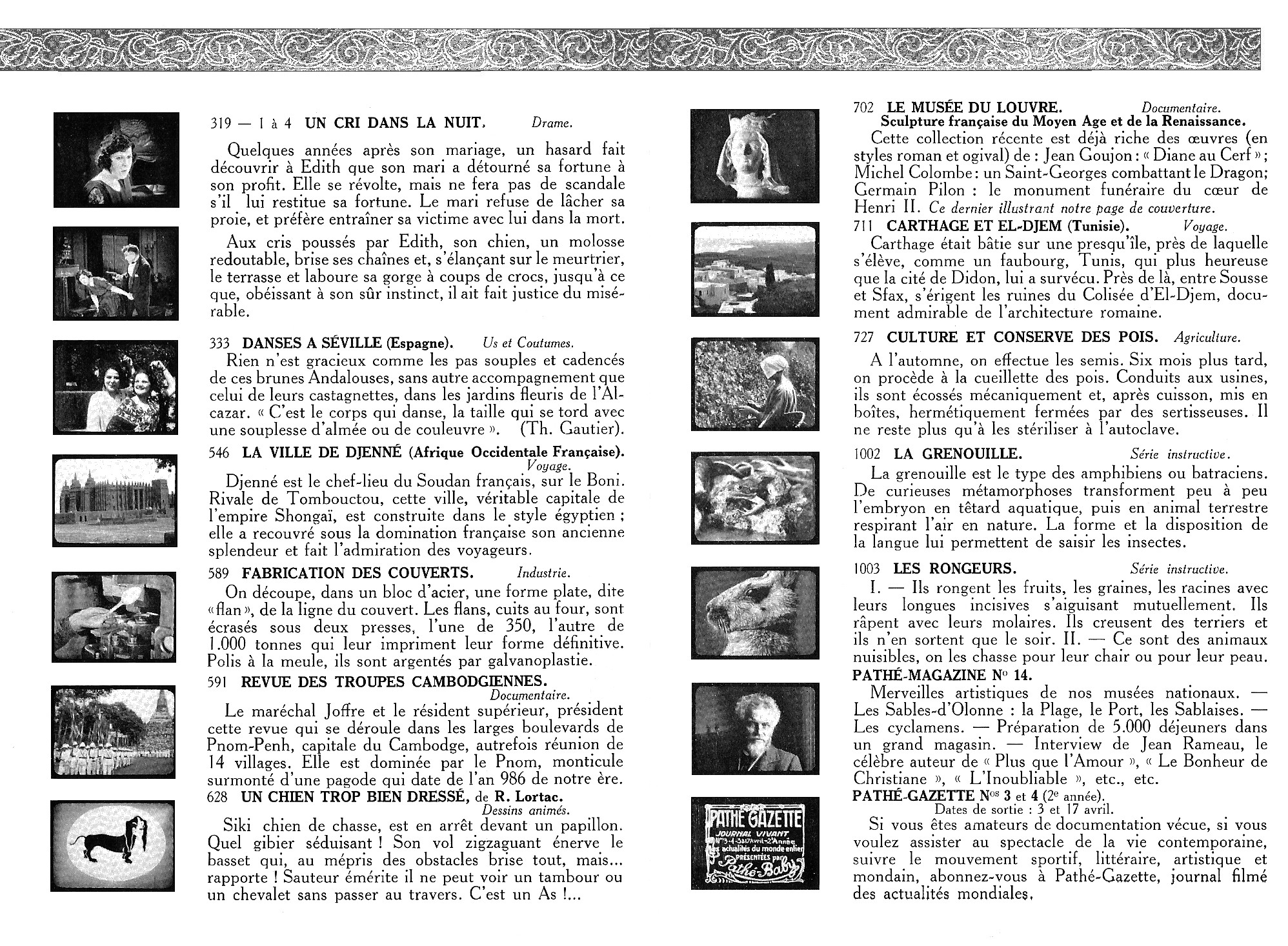
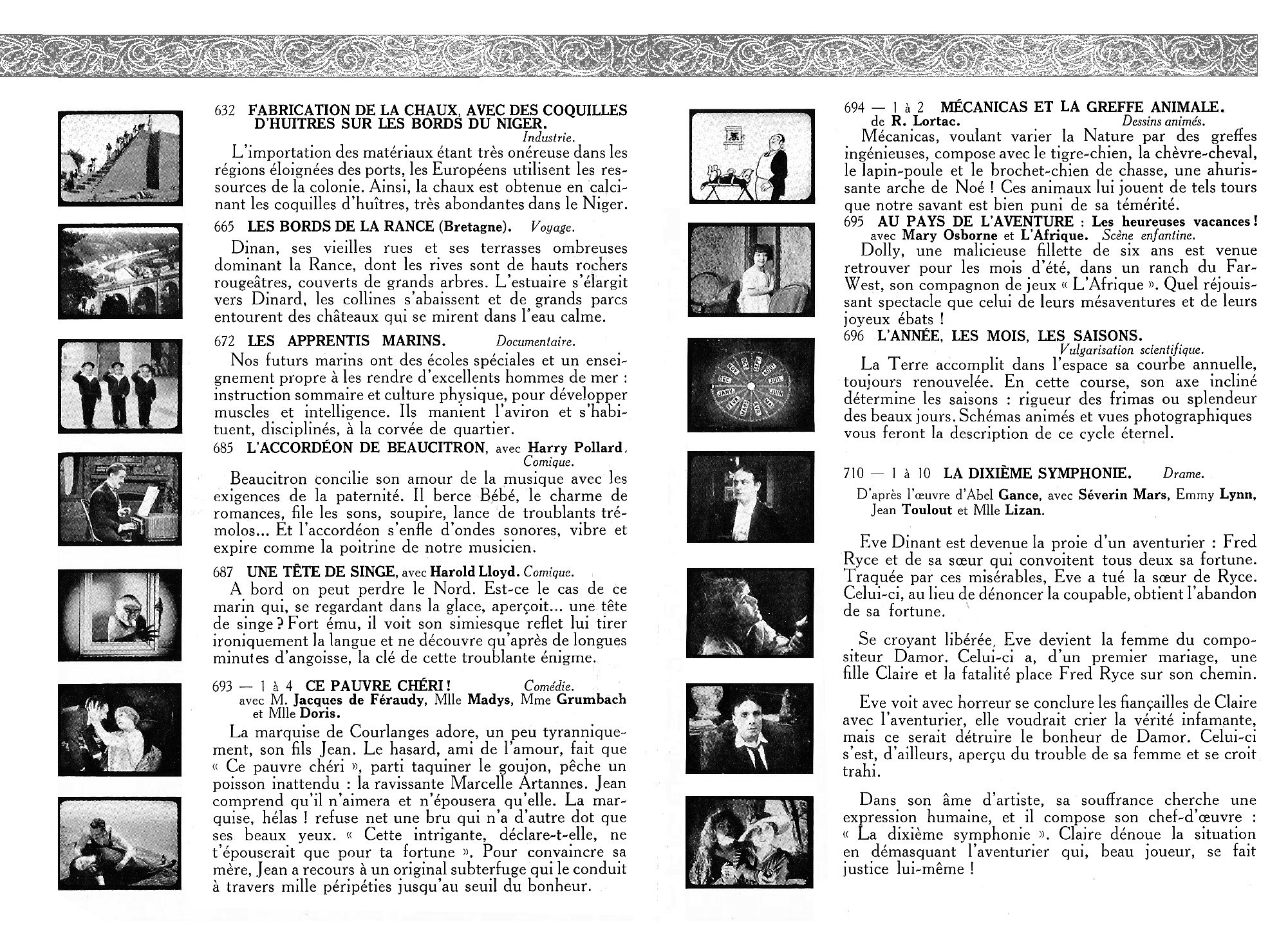

July-August 1924


September 1924


November 1924
For some reason, the two centre pix escaped the Great Software Disaster of 2014, which is why these look a bit different.


December 1924


February 1925


March 1925


June-July 1925


August-September 1925


October 1925


The French illustrated catalogue for 1928 is available from me on CD-ROM for 3 post paid. It has around 270 pages; here are some sample pages.


The 1930 version is even more extensive, running to about 340 pages. I have made a quick comparison of the main numerical series.
1000 series: 1928 last No. 1154; 1930 1226
2000 series: 1928 last No. 2055; 1930 2099
3000 series: 1928 last No. 3008; 1930 3043
4000 series: 1928 None; 1930 4000 - 4029 inclusive.
5000 series: 1928 last No. 50001; 1930 5004
10,000 series: 1928 last No. 10198; 1930 10199 plus 10078, 10098, 10099 which do not appear in 1930.
None of this takes account of any numbers that may have been dropped from the catalogue.
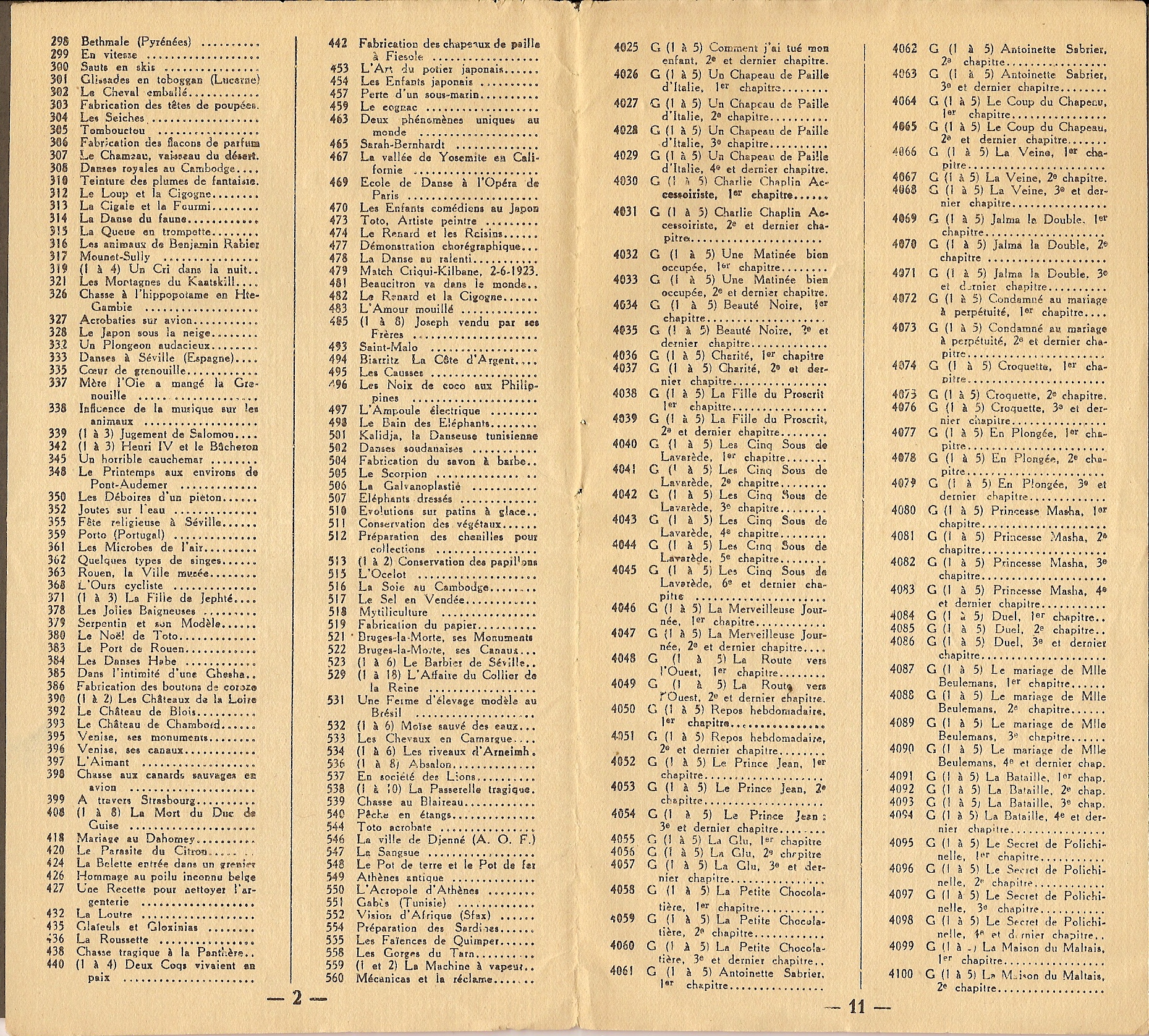
French 1931






English Catalogues
See also the monthly/bi-monthly film release leaflets that preceded Pathescope Monthly, in Before PM.
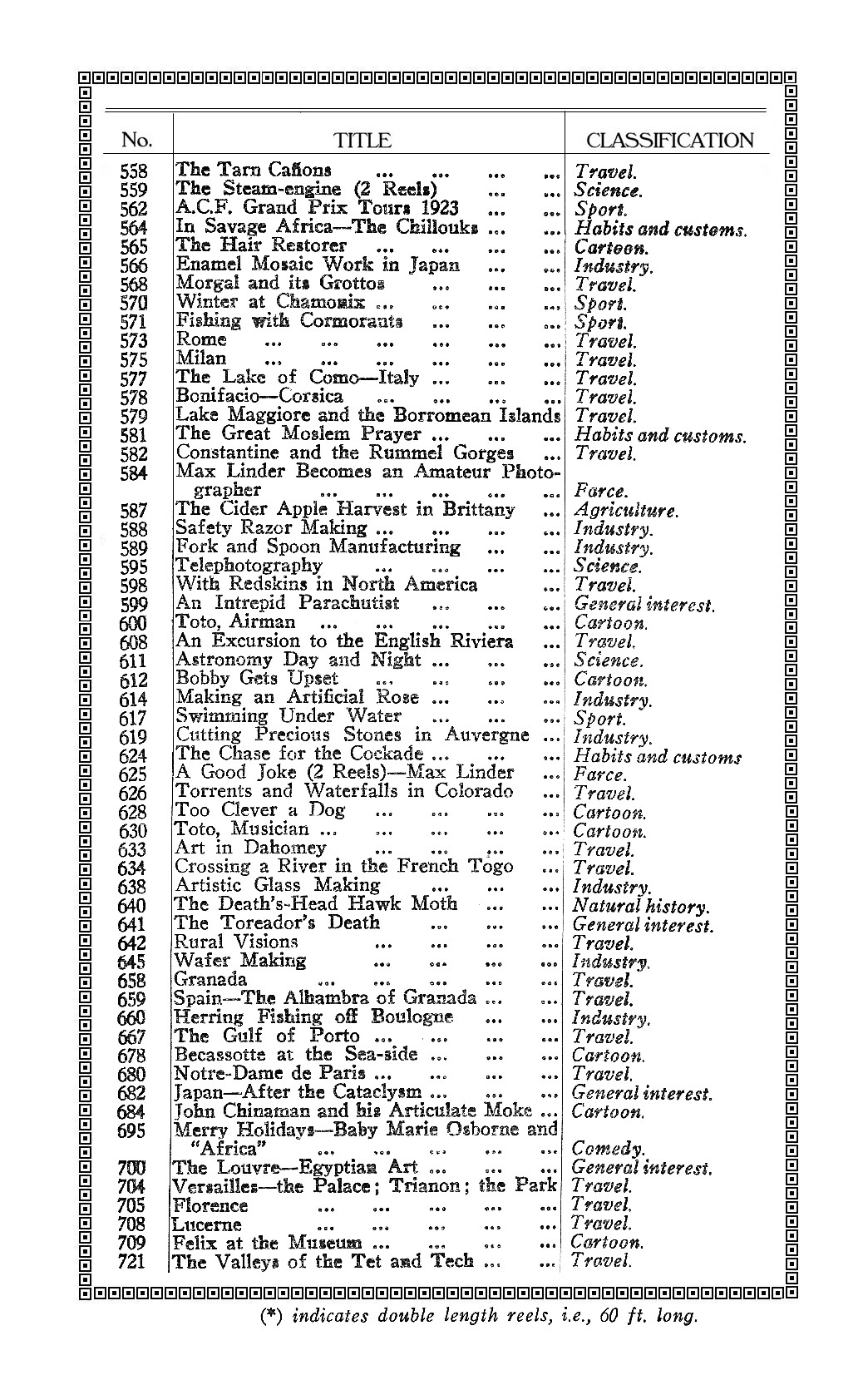
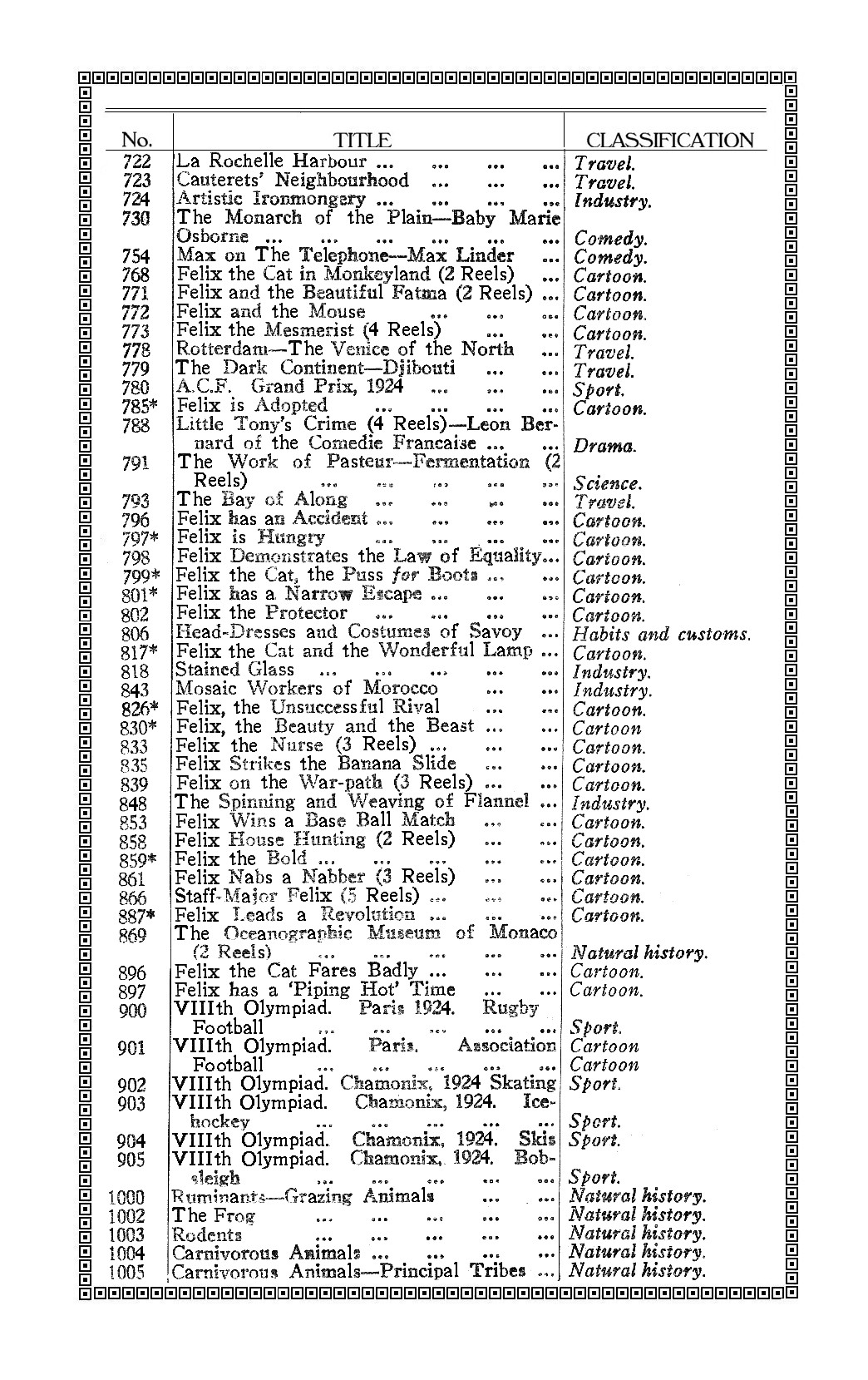
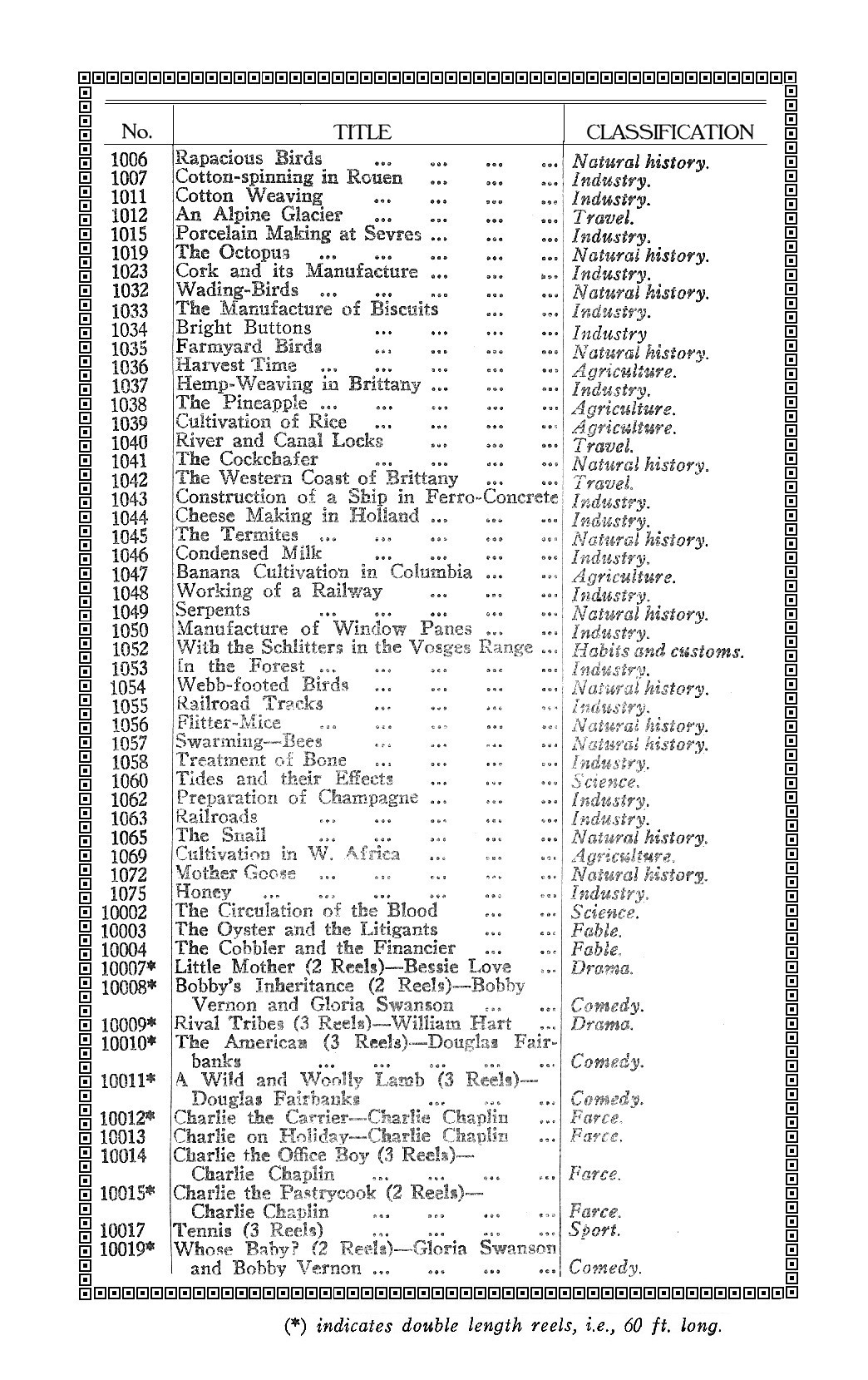
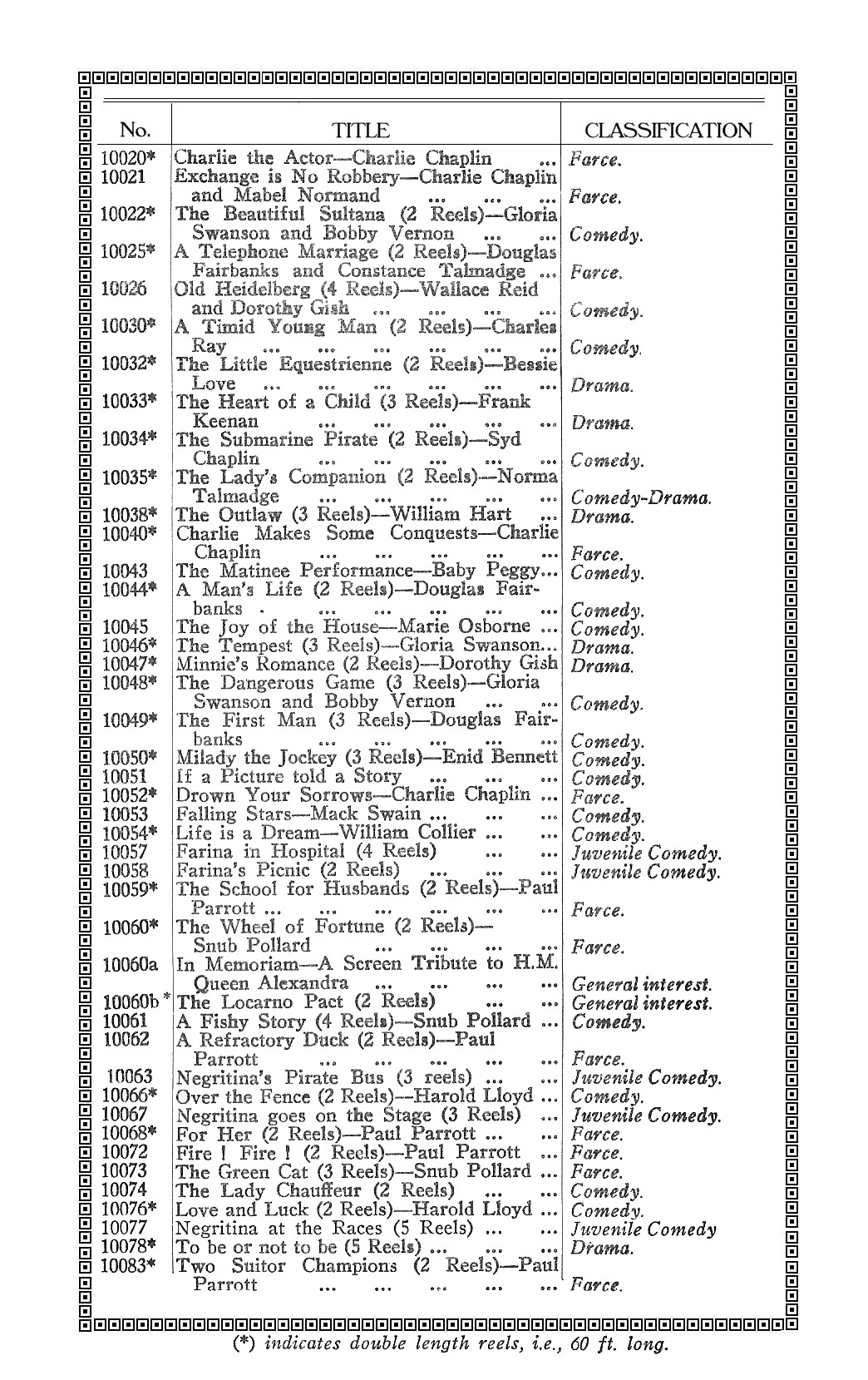
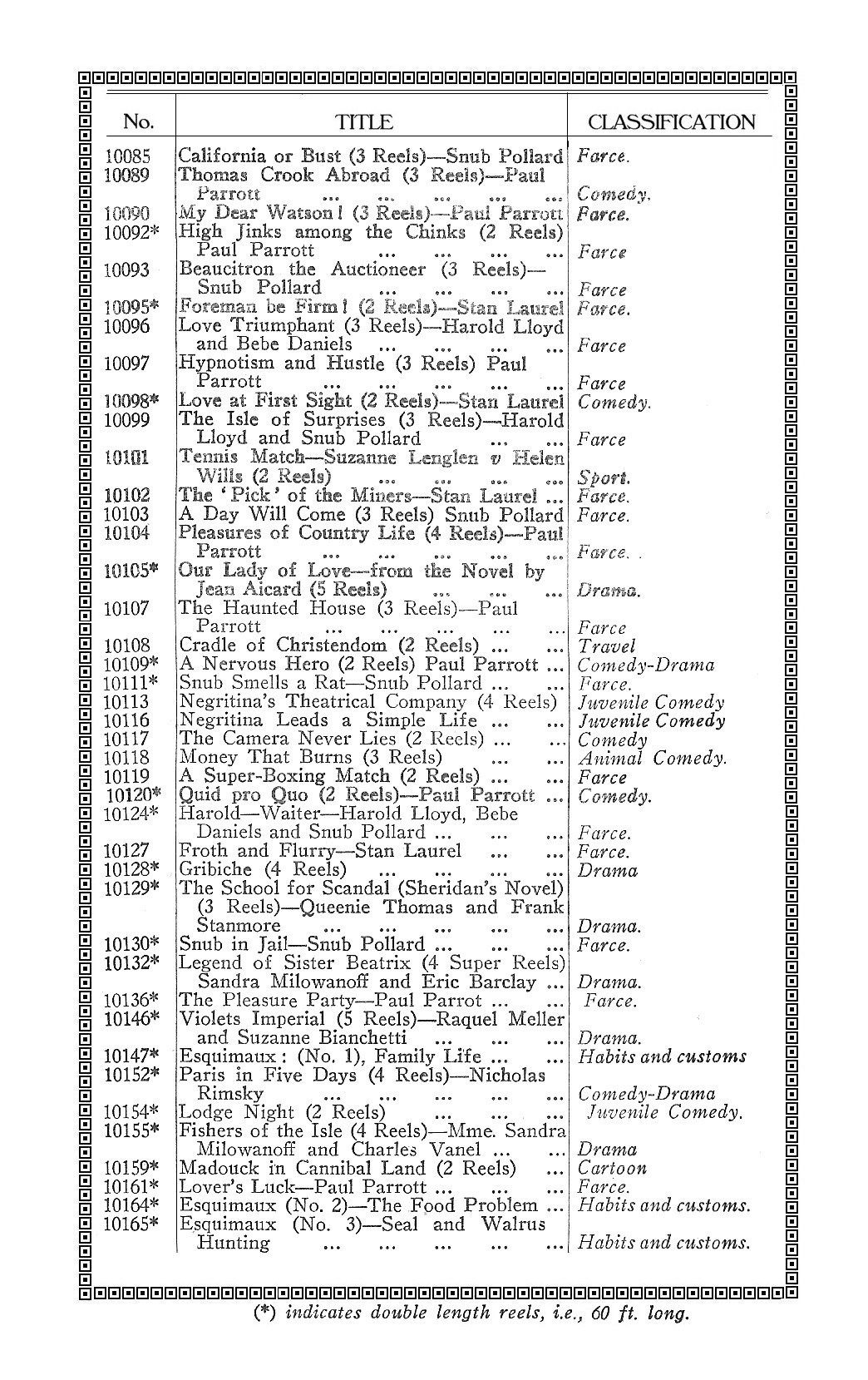
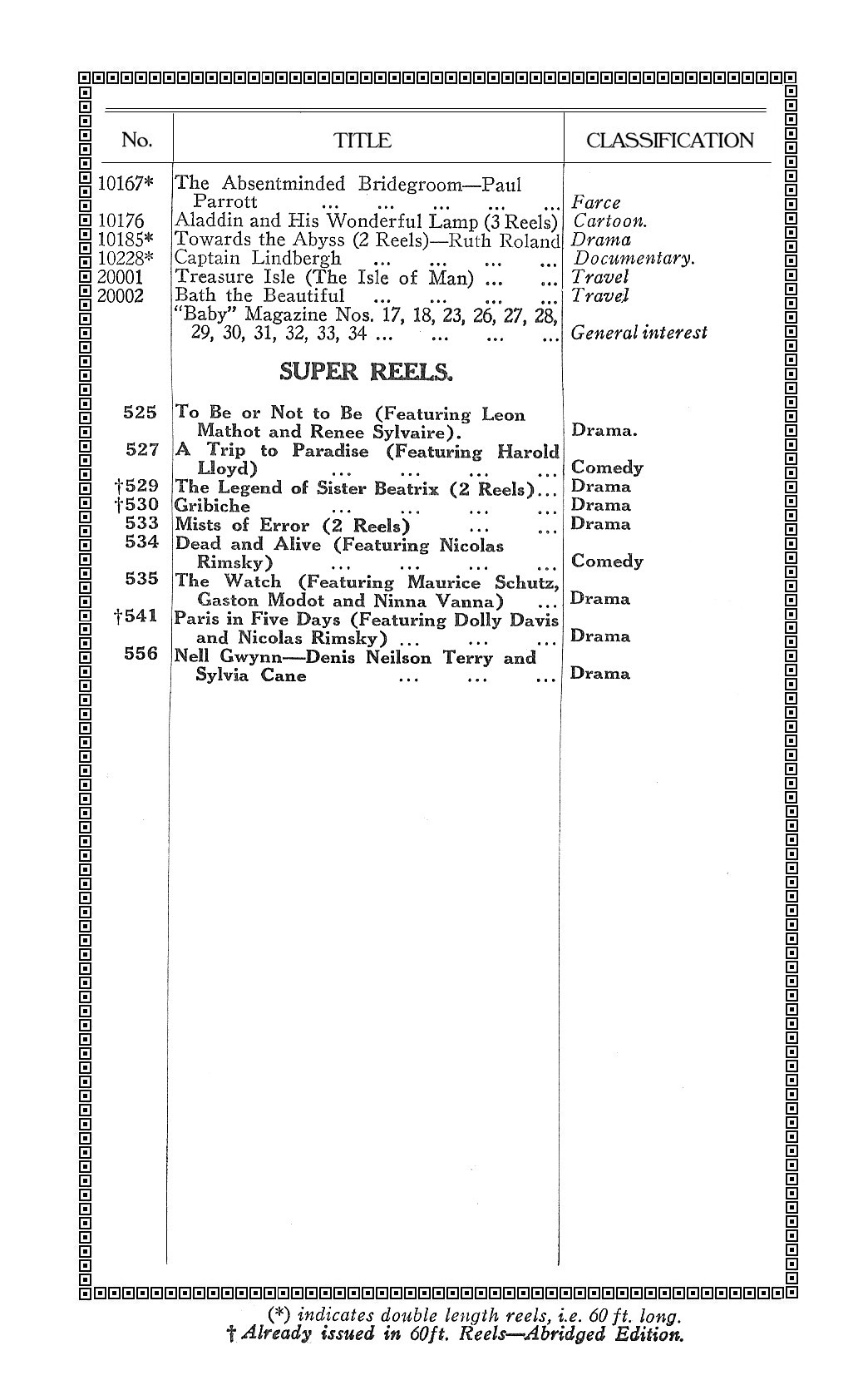
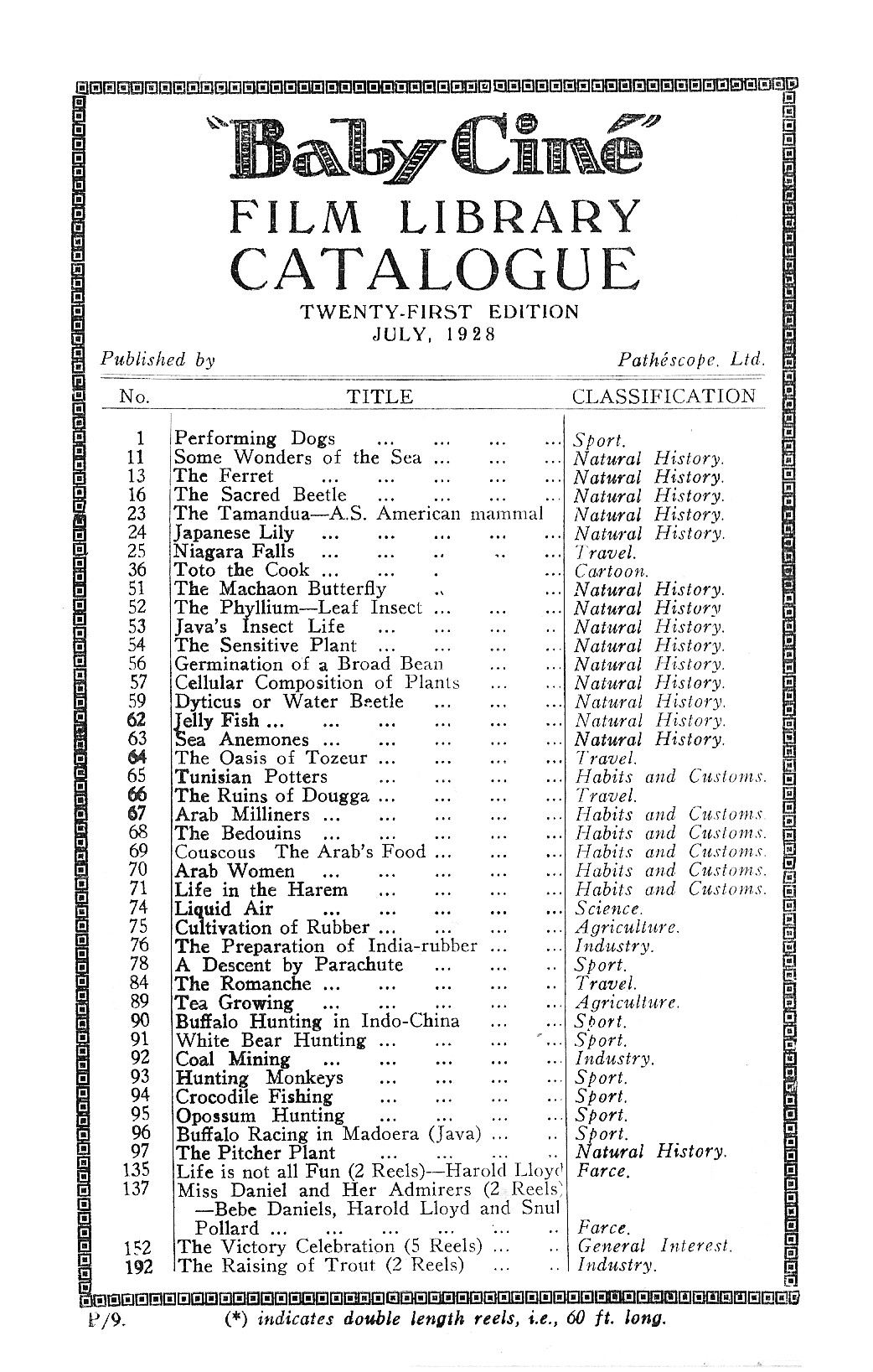
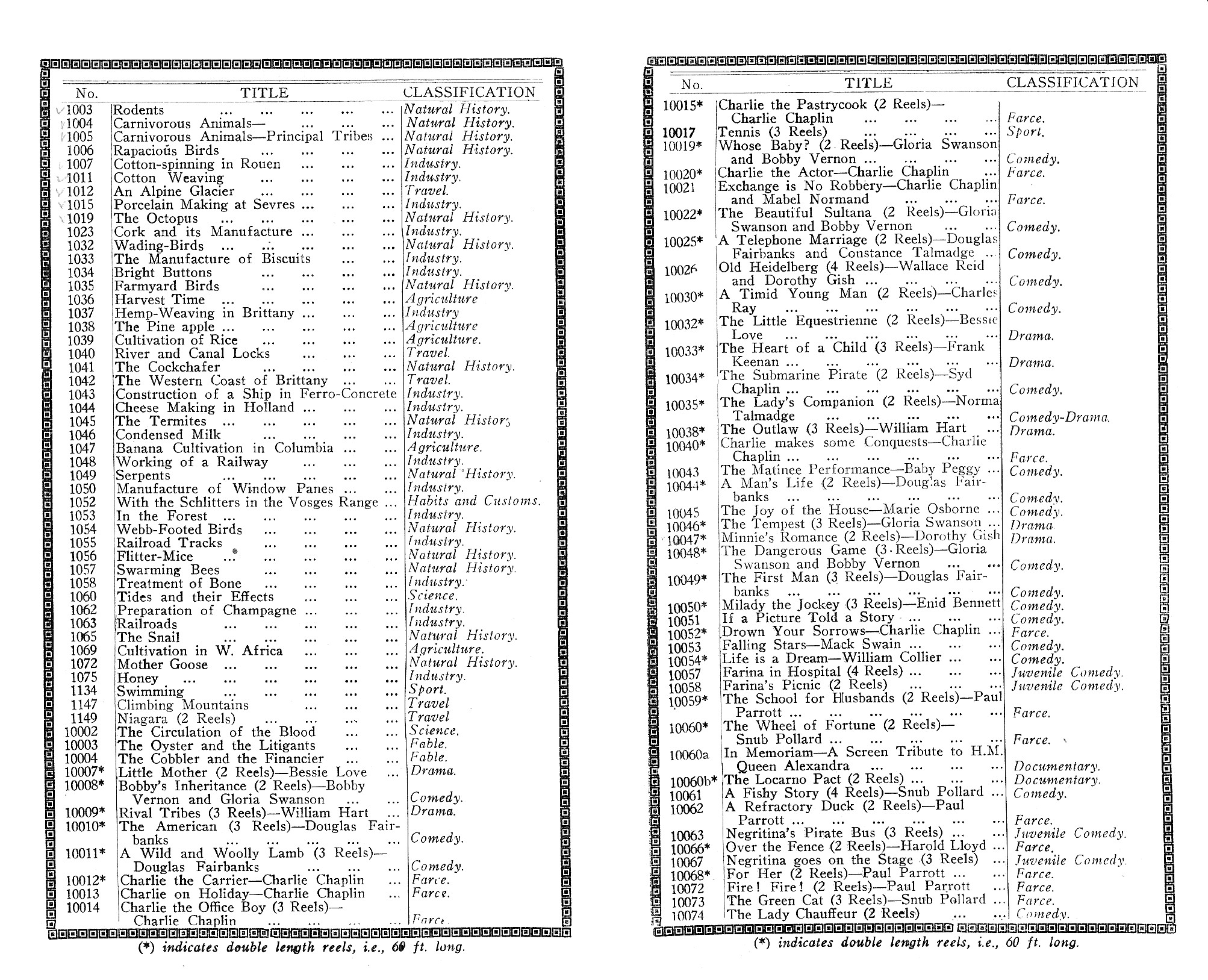
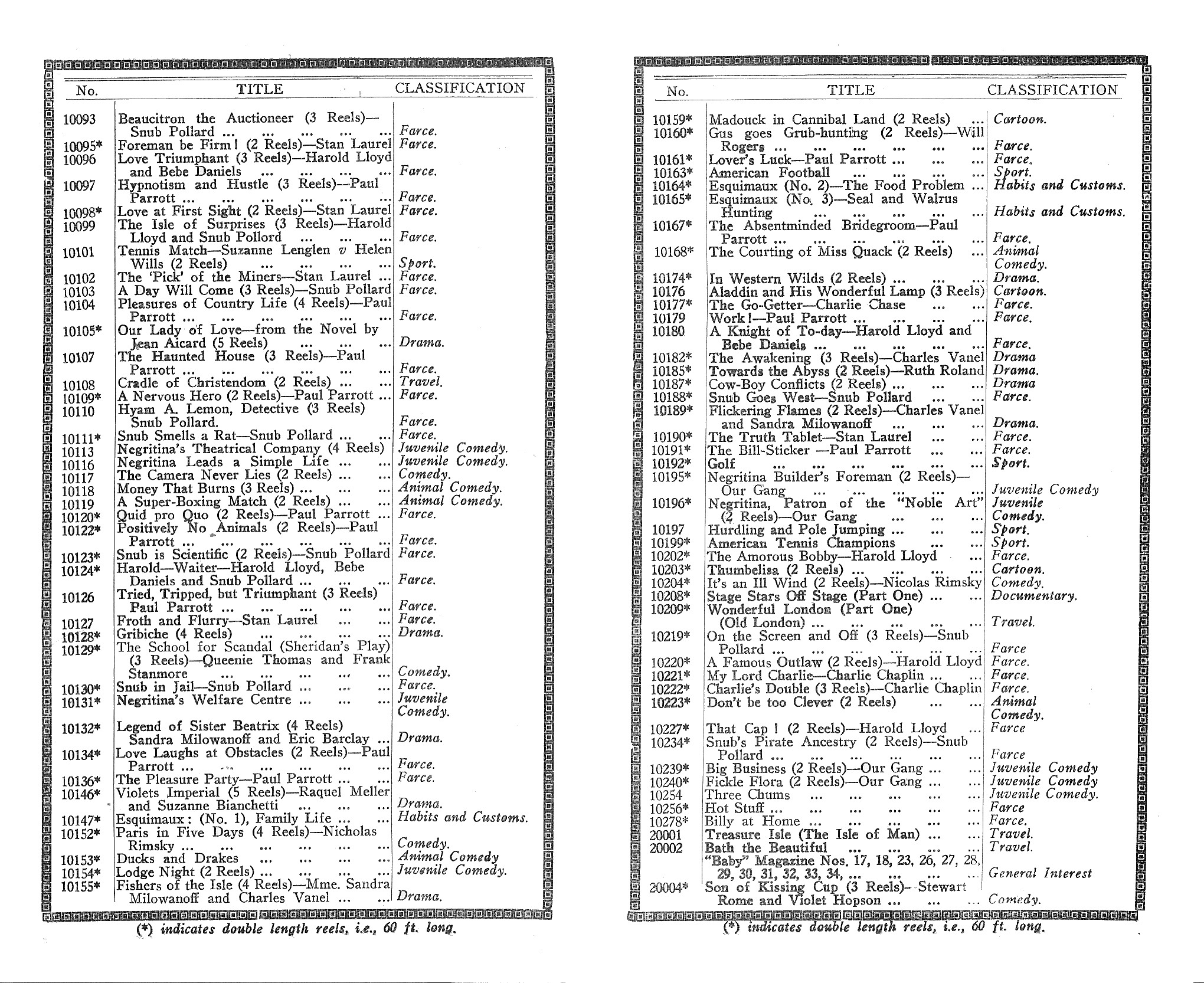
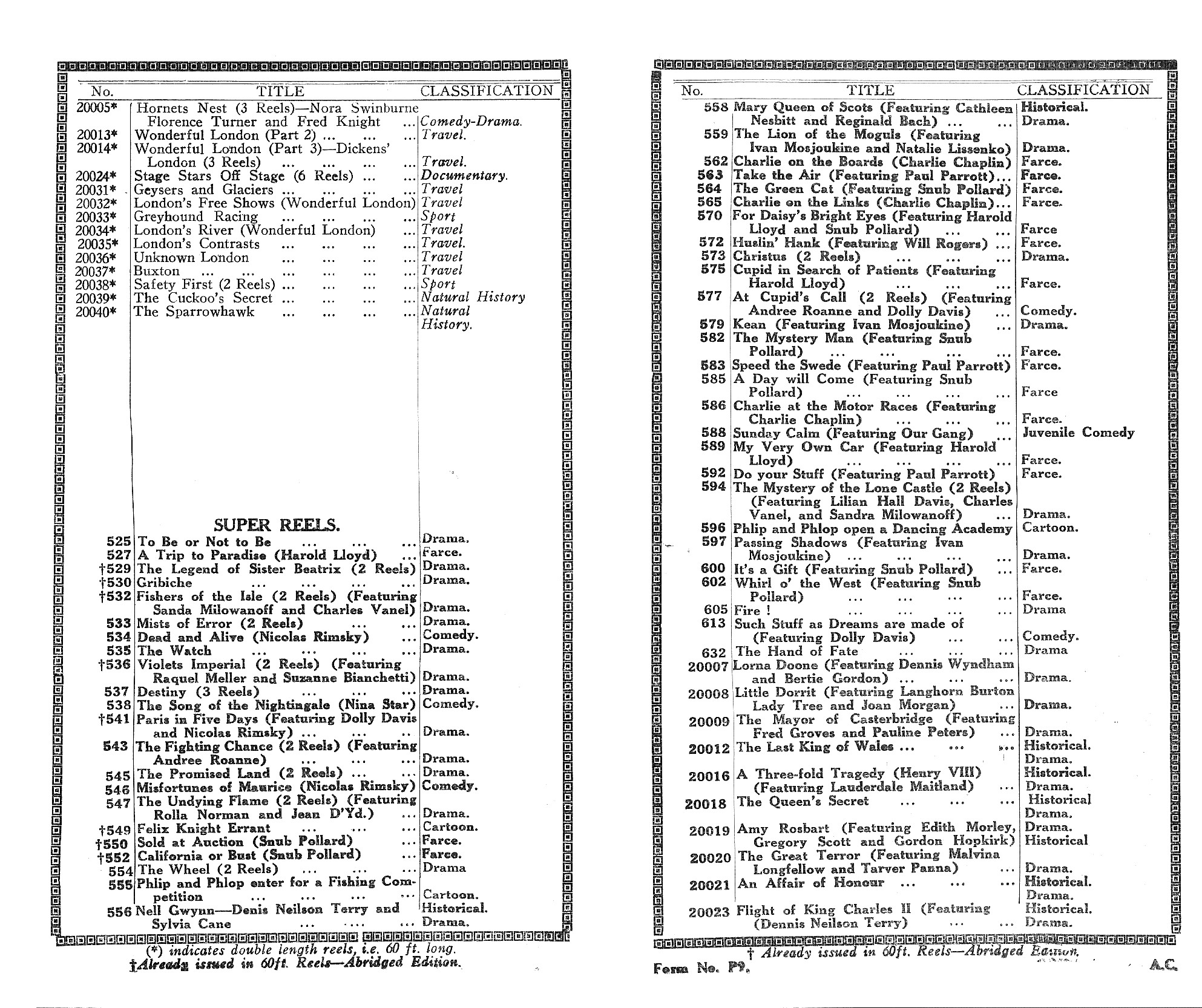
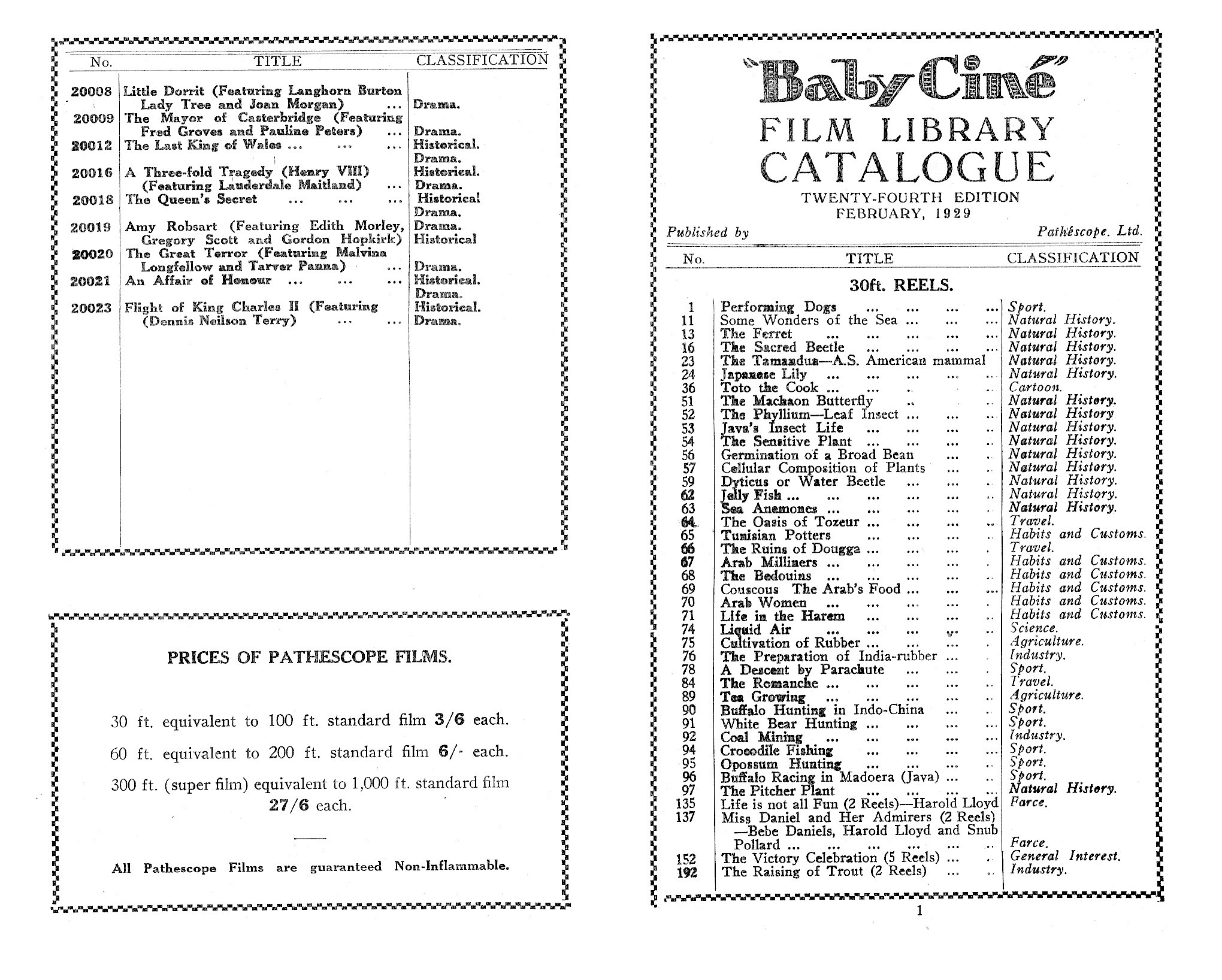
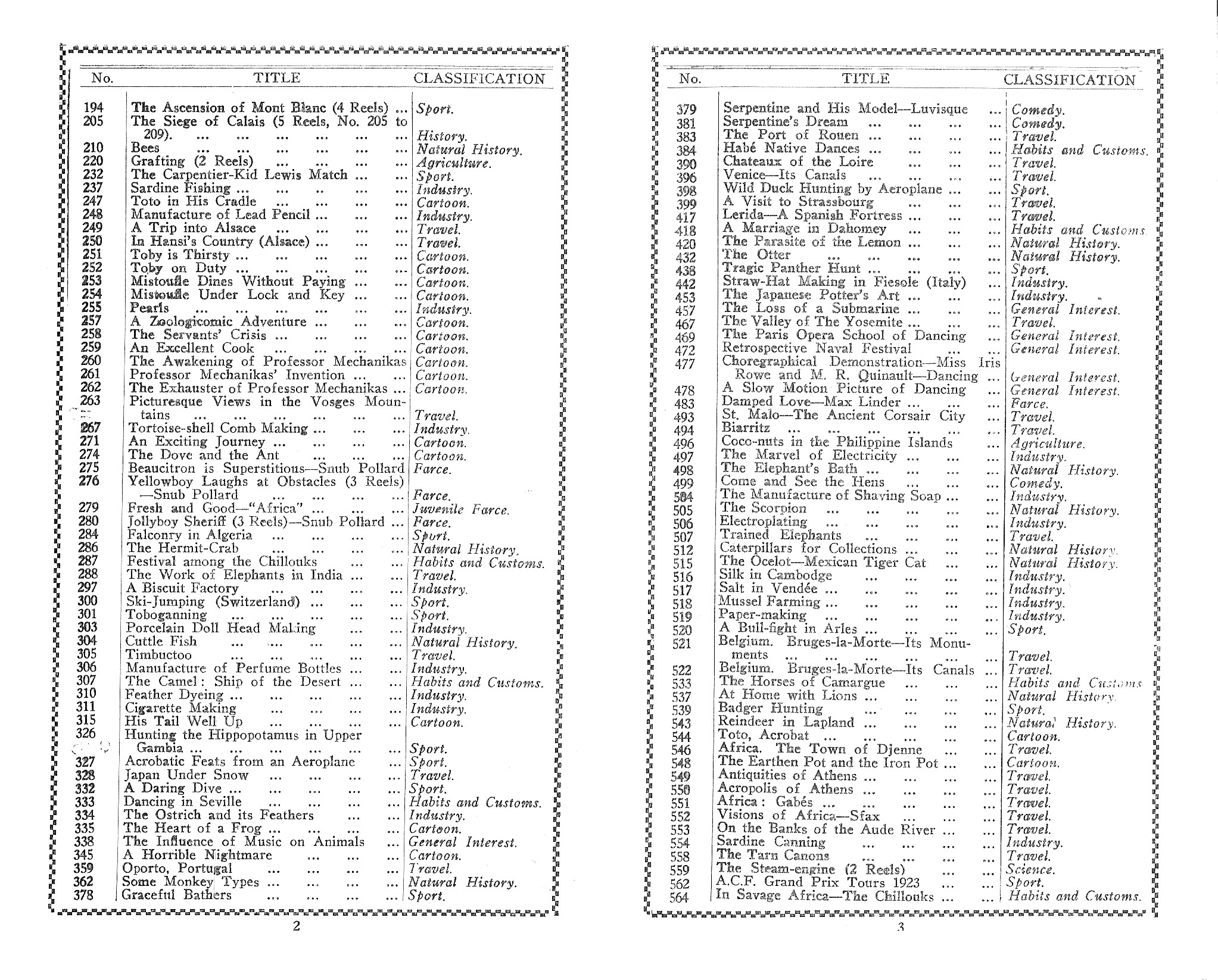
I believe the Preliminary Catalogue below to be the very first British catalogue, issued in 1924.
Preliminary List


!st


6th


10th


11th


15th
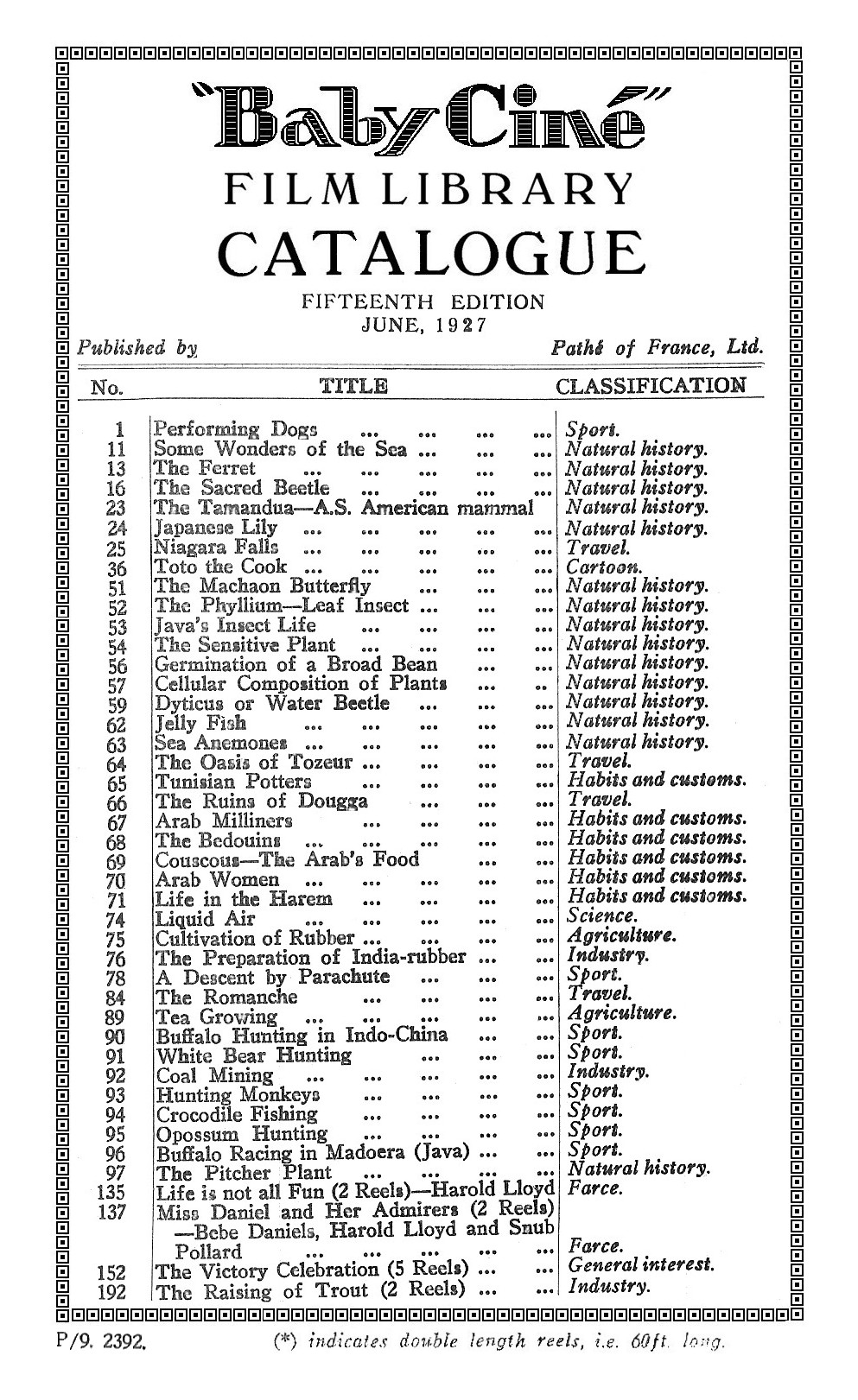
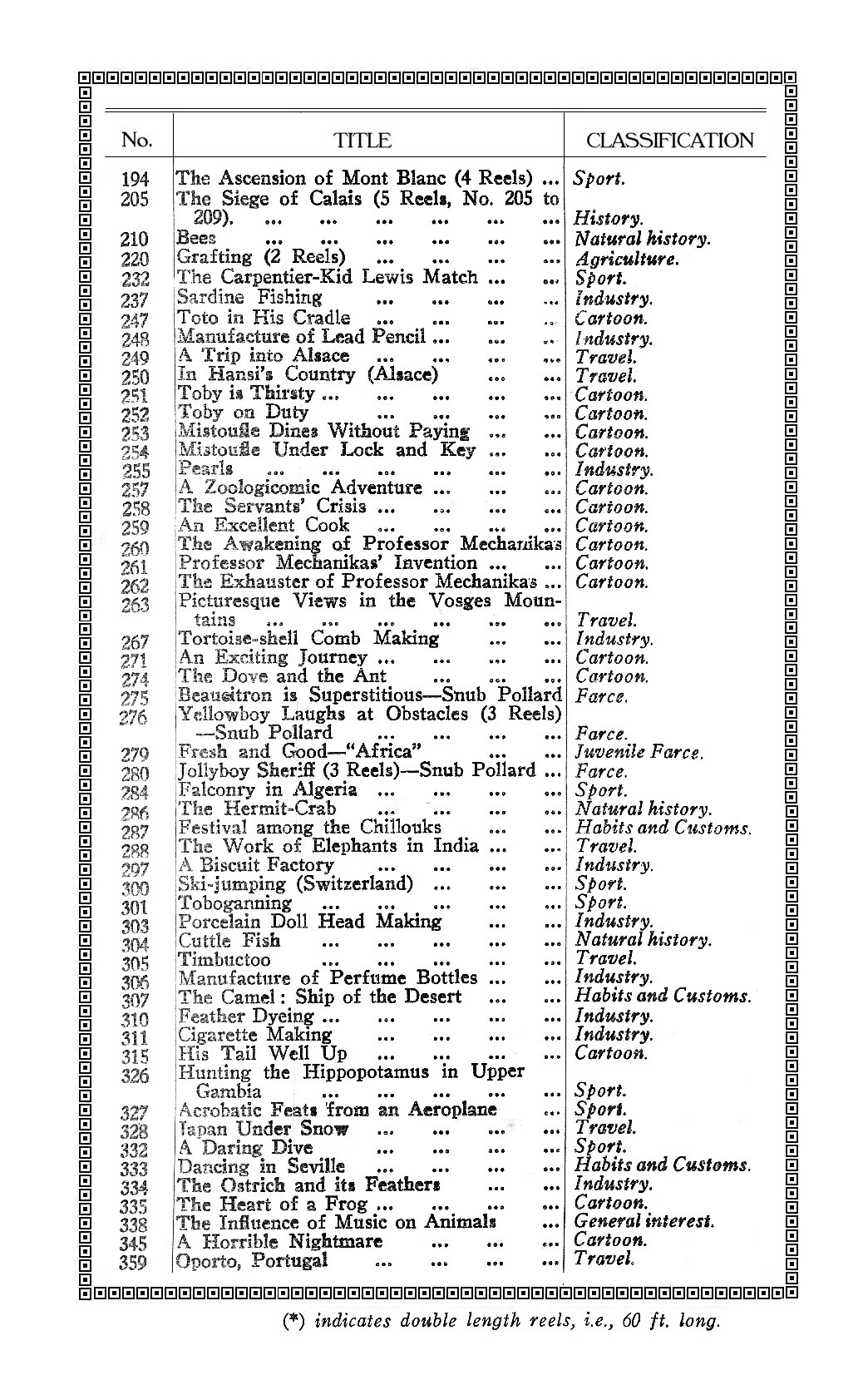
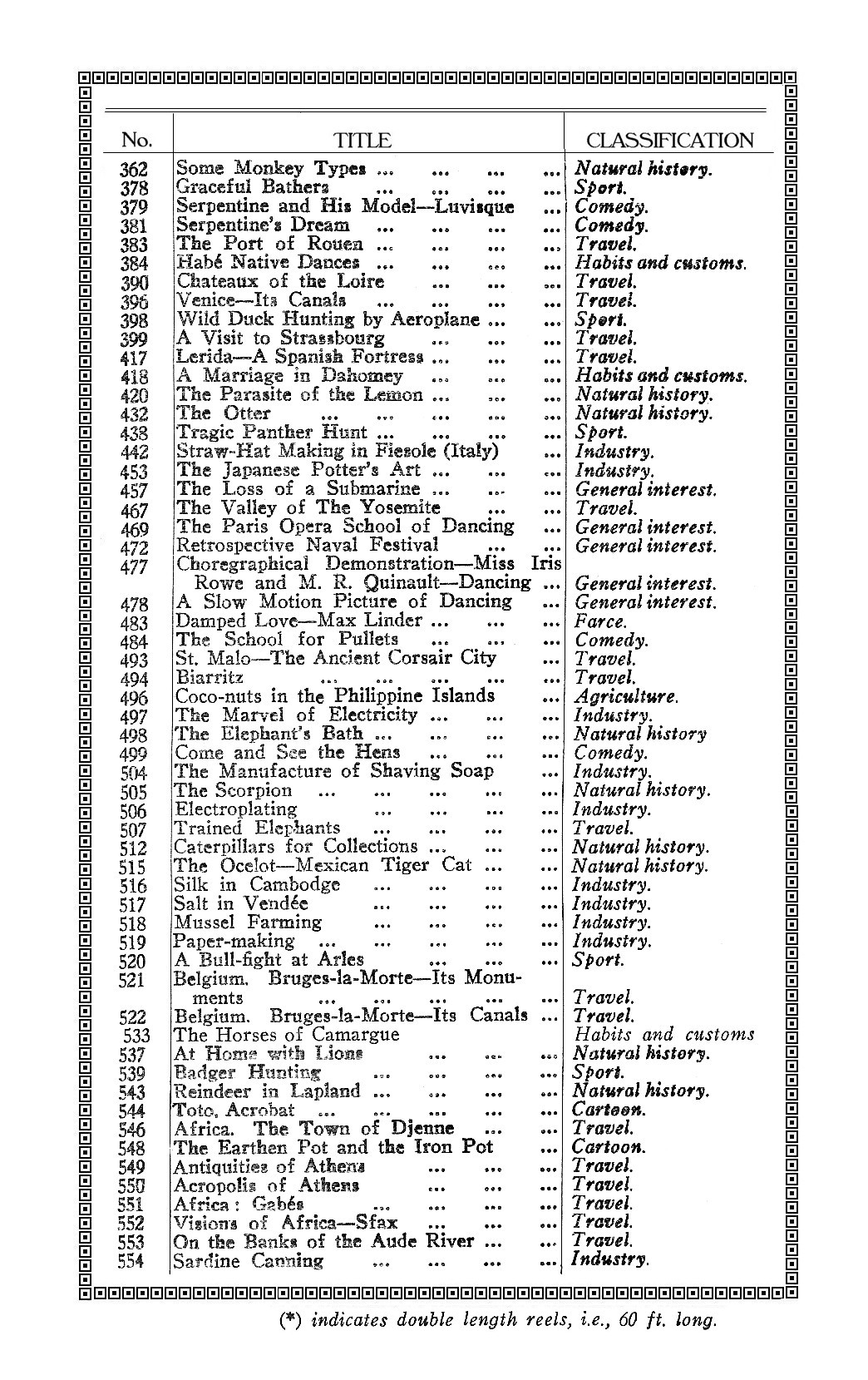

20th


21st


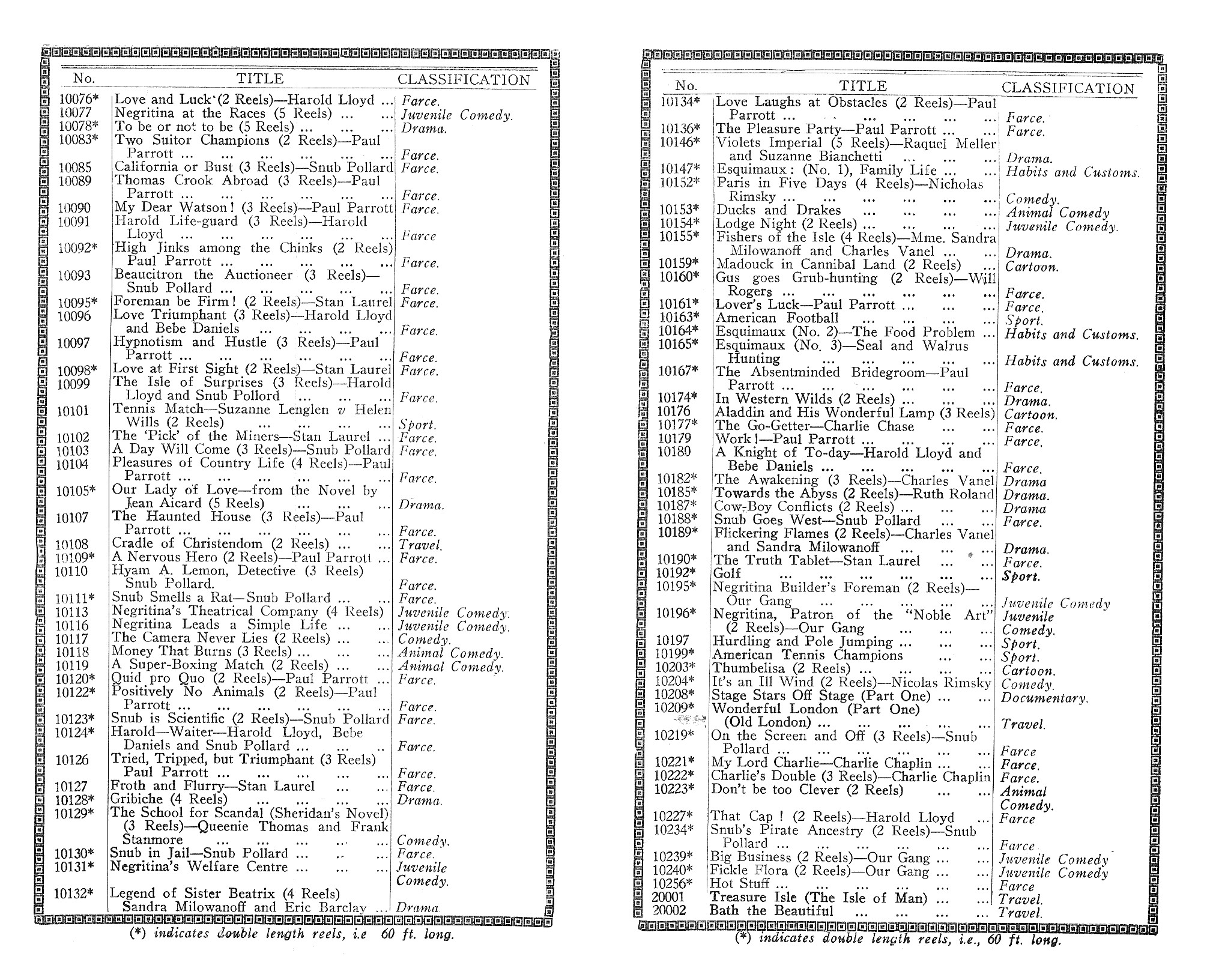
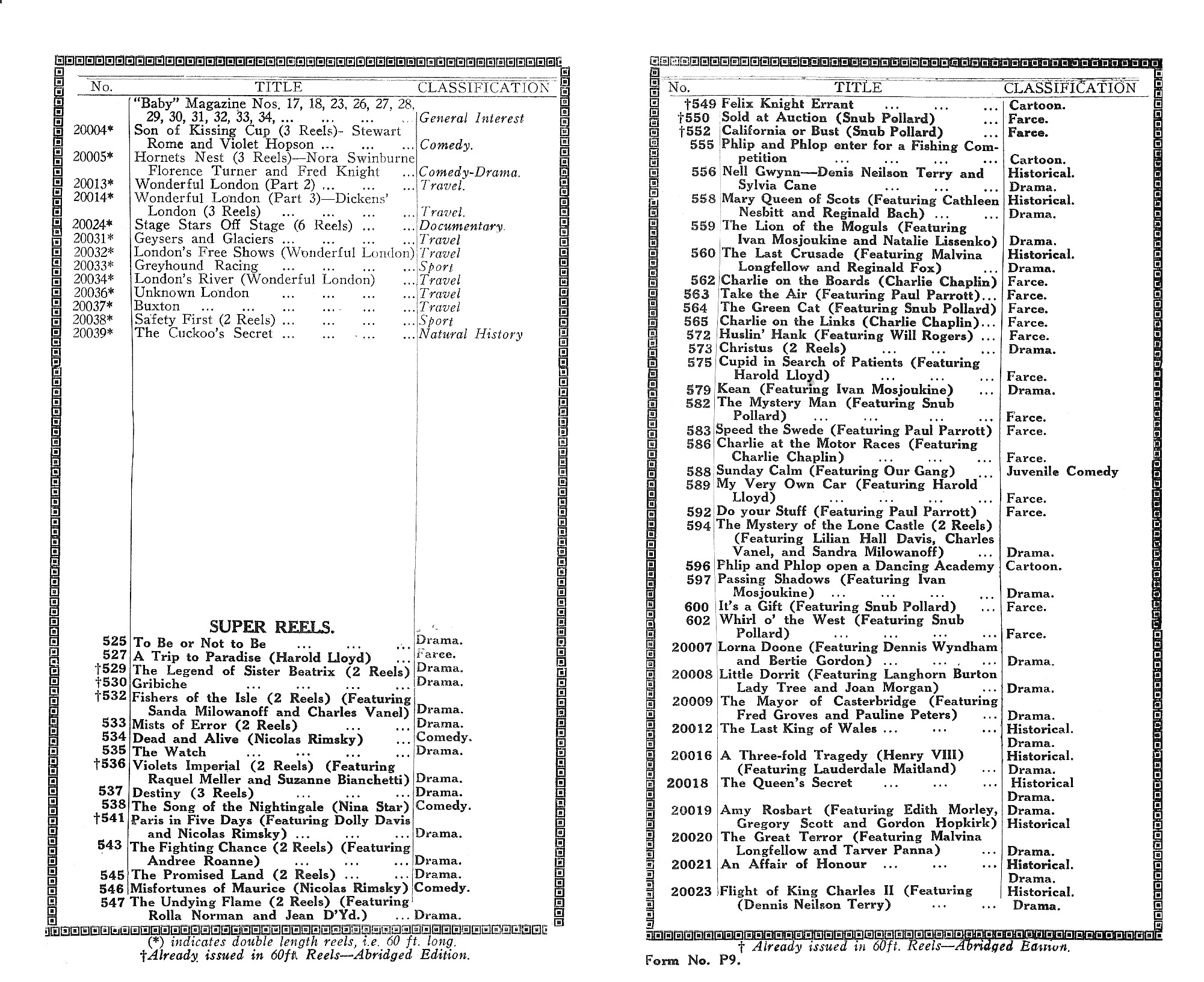
22nd
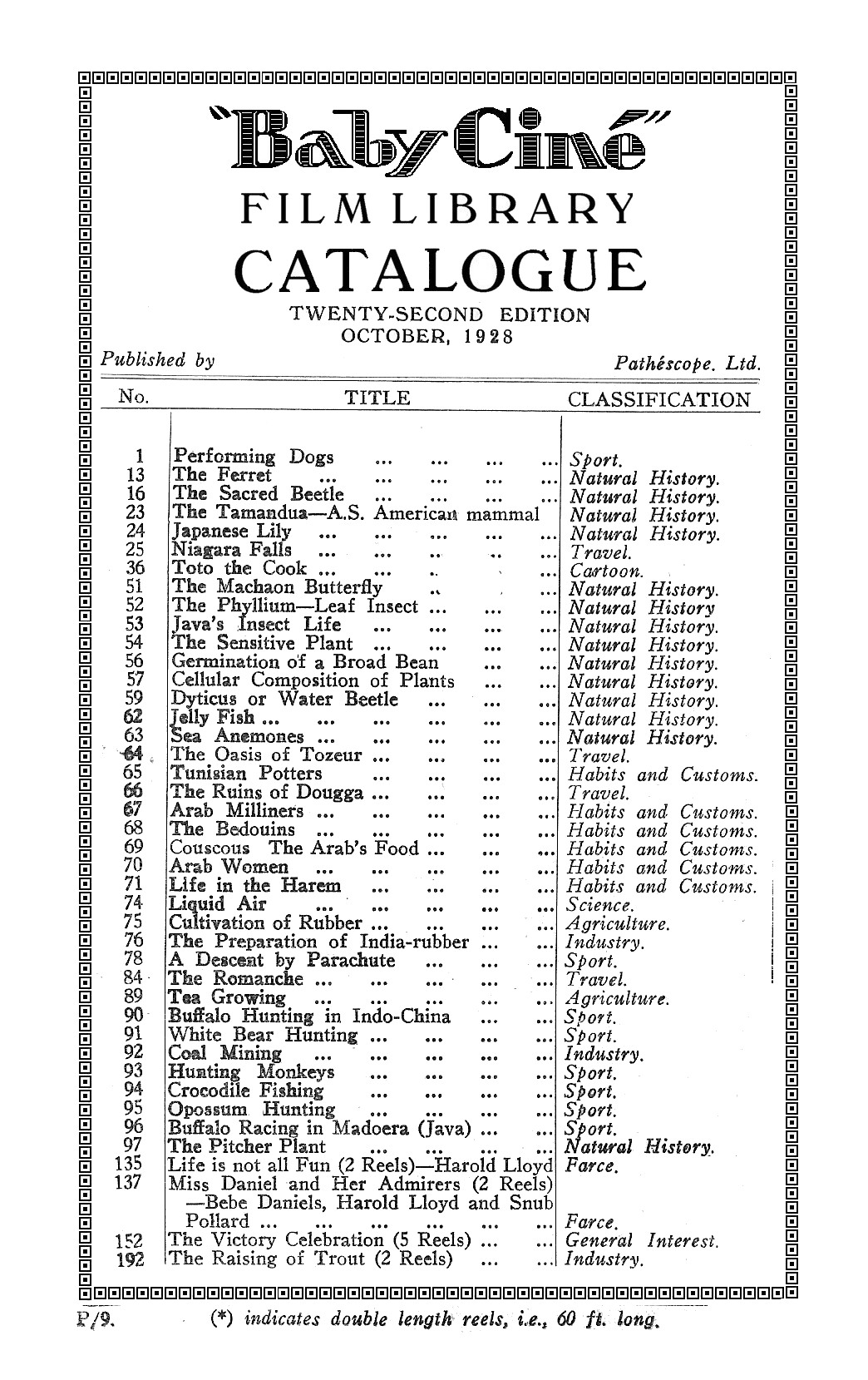


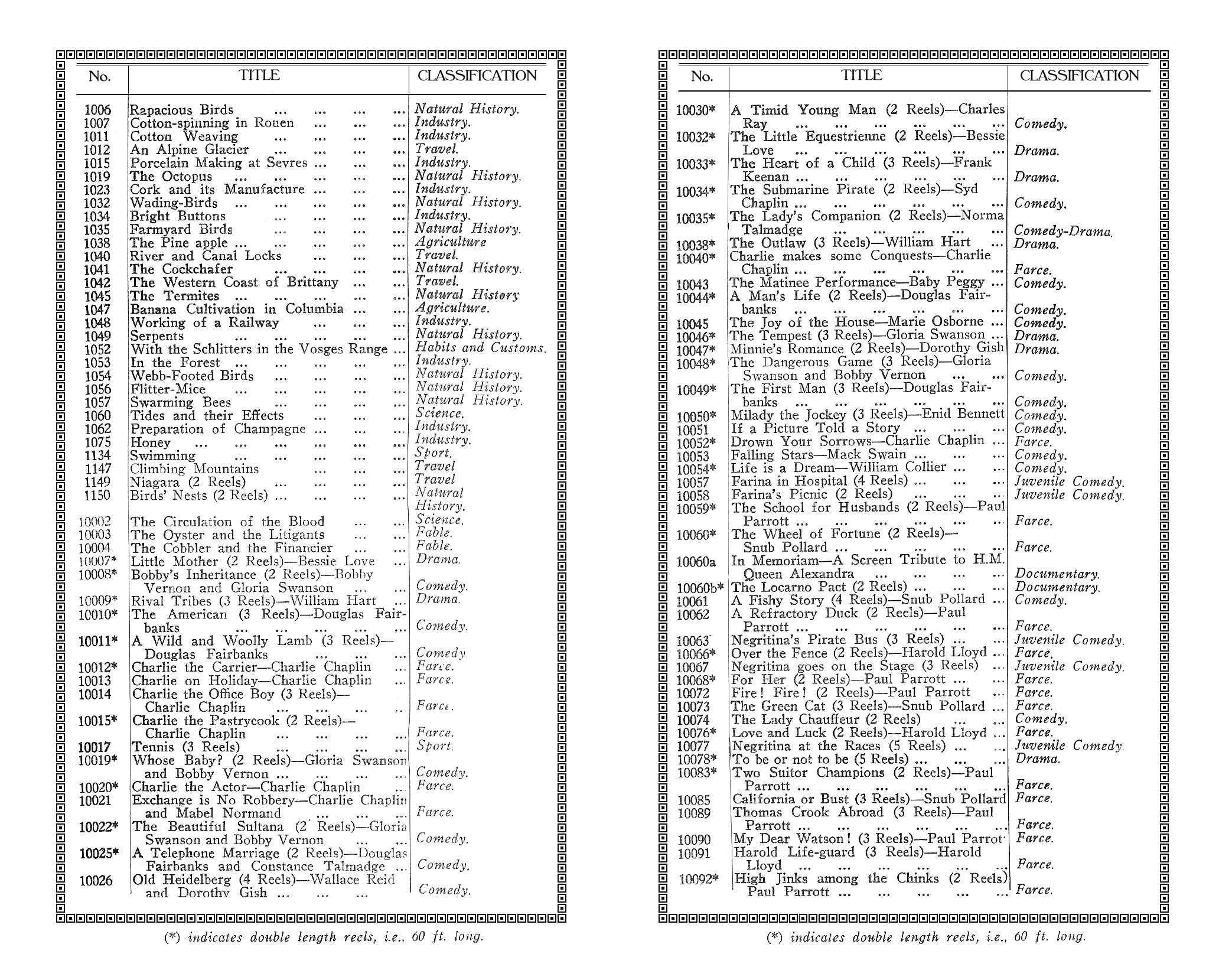
24th
27th
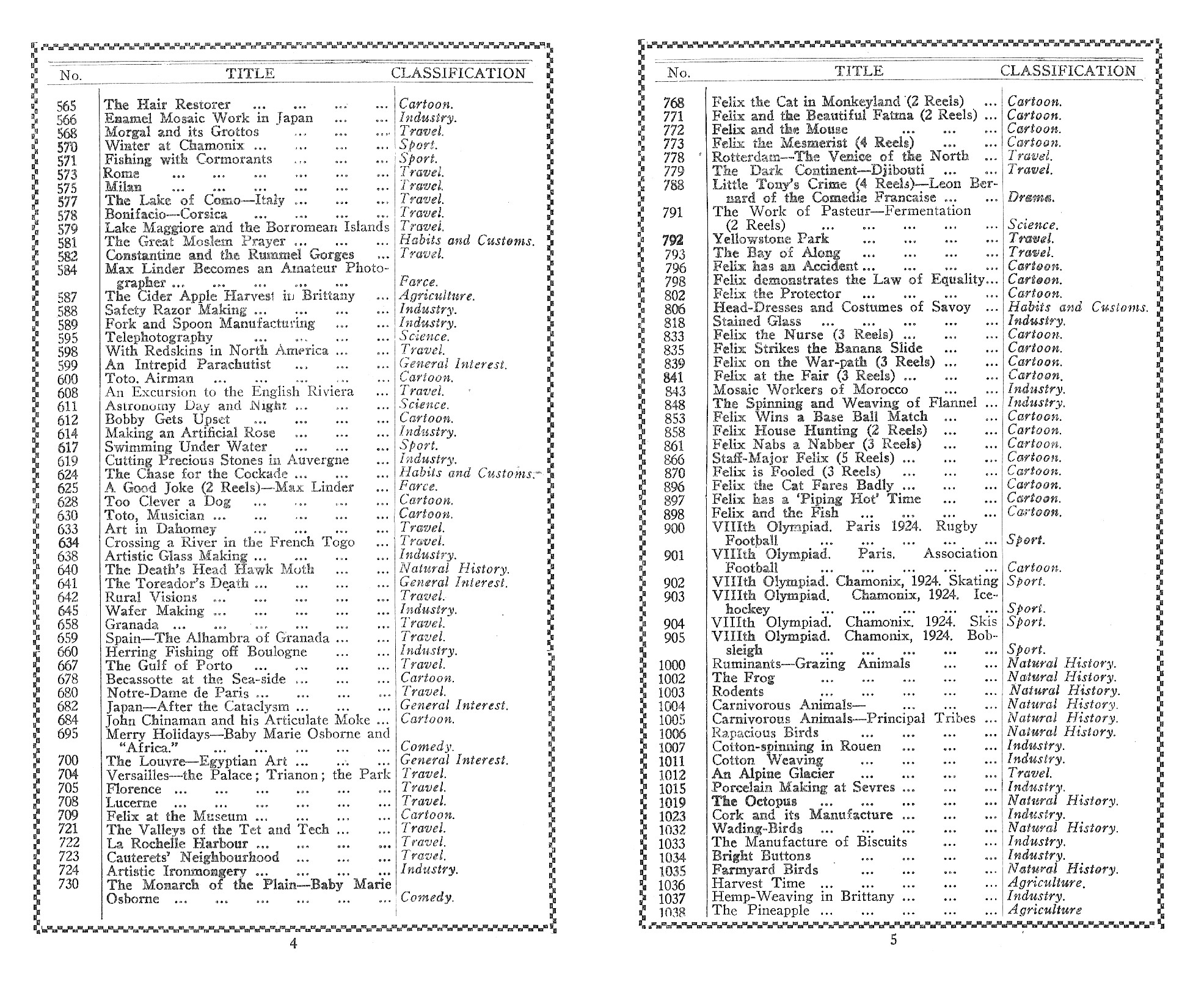
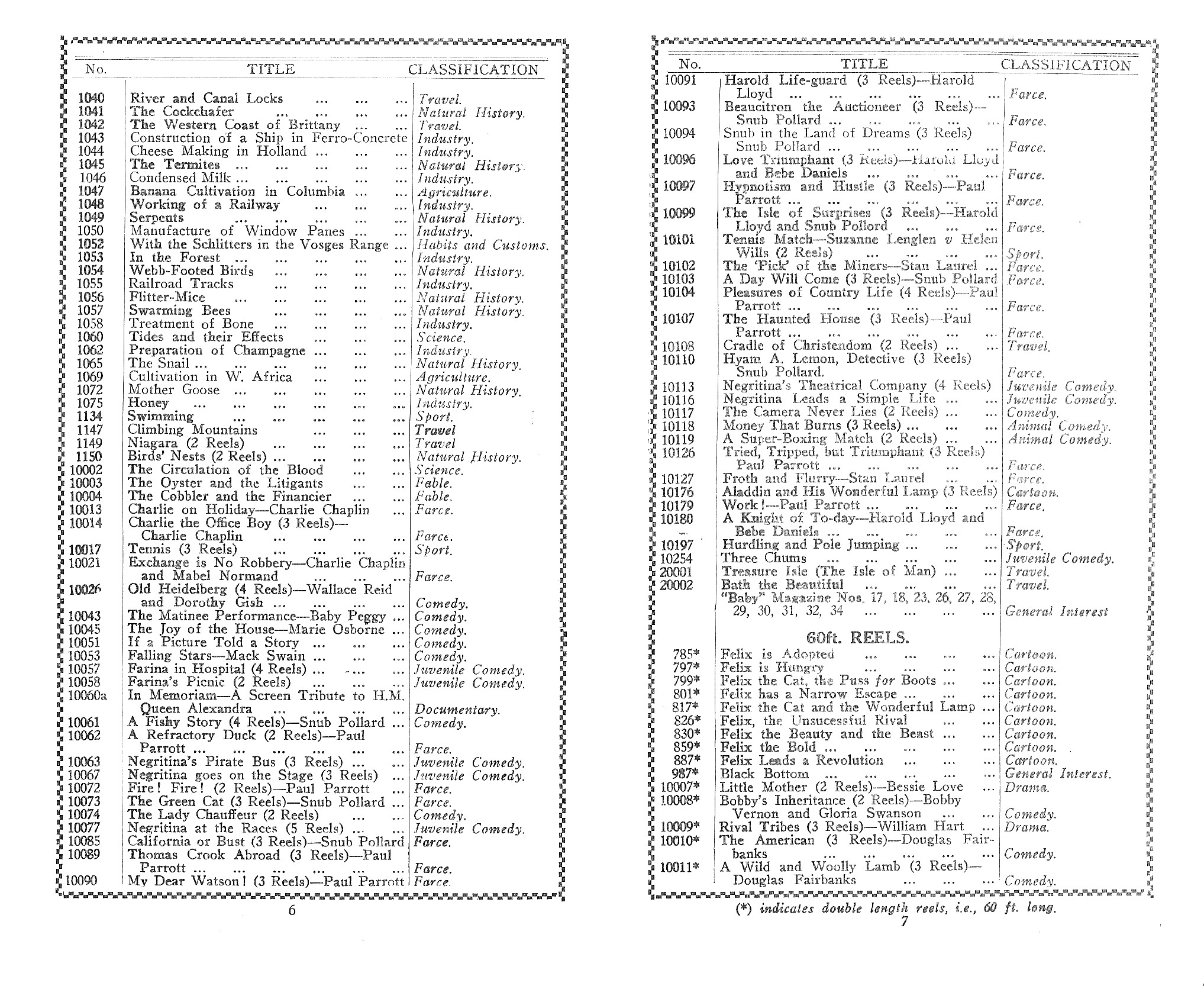
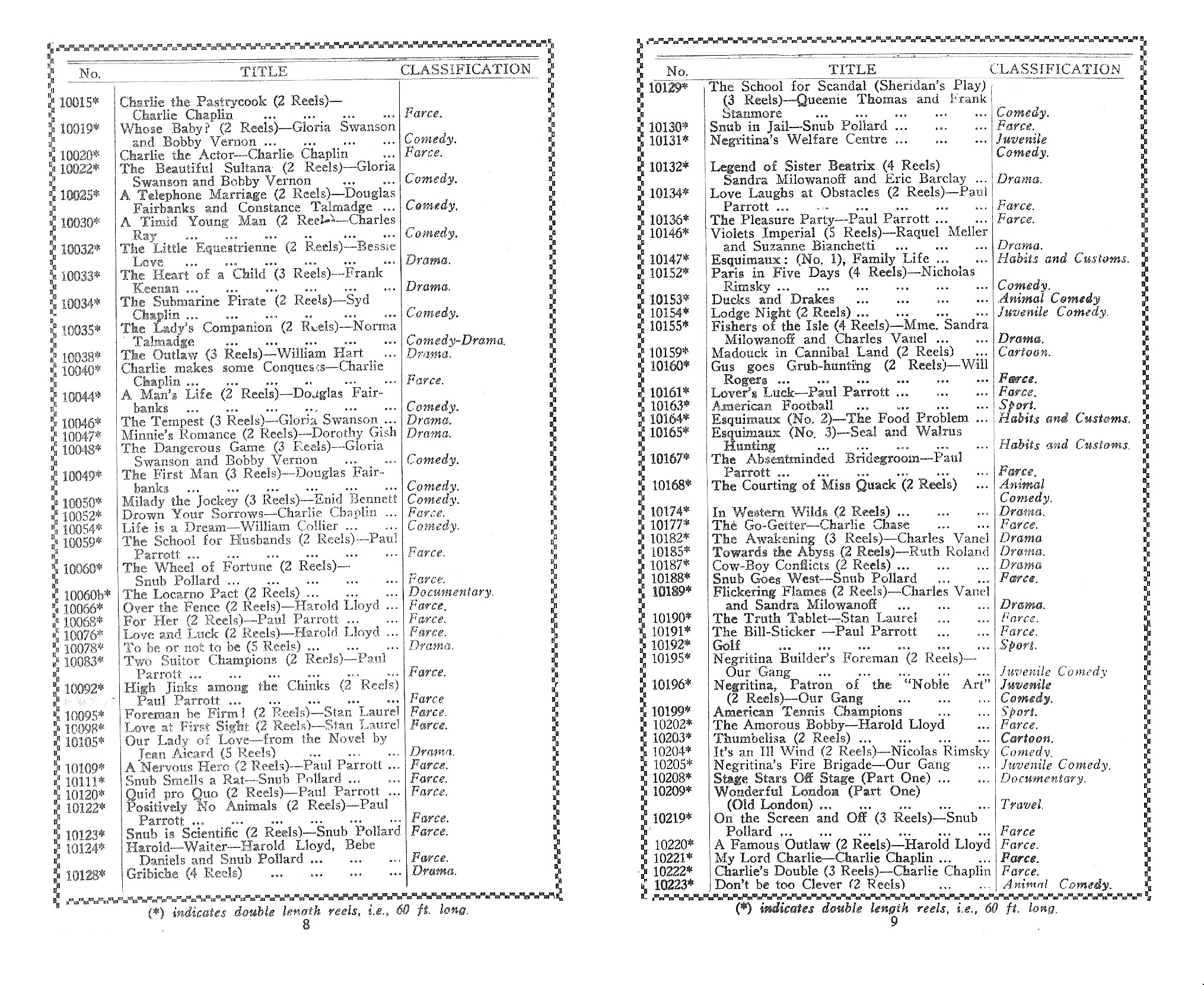
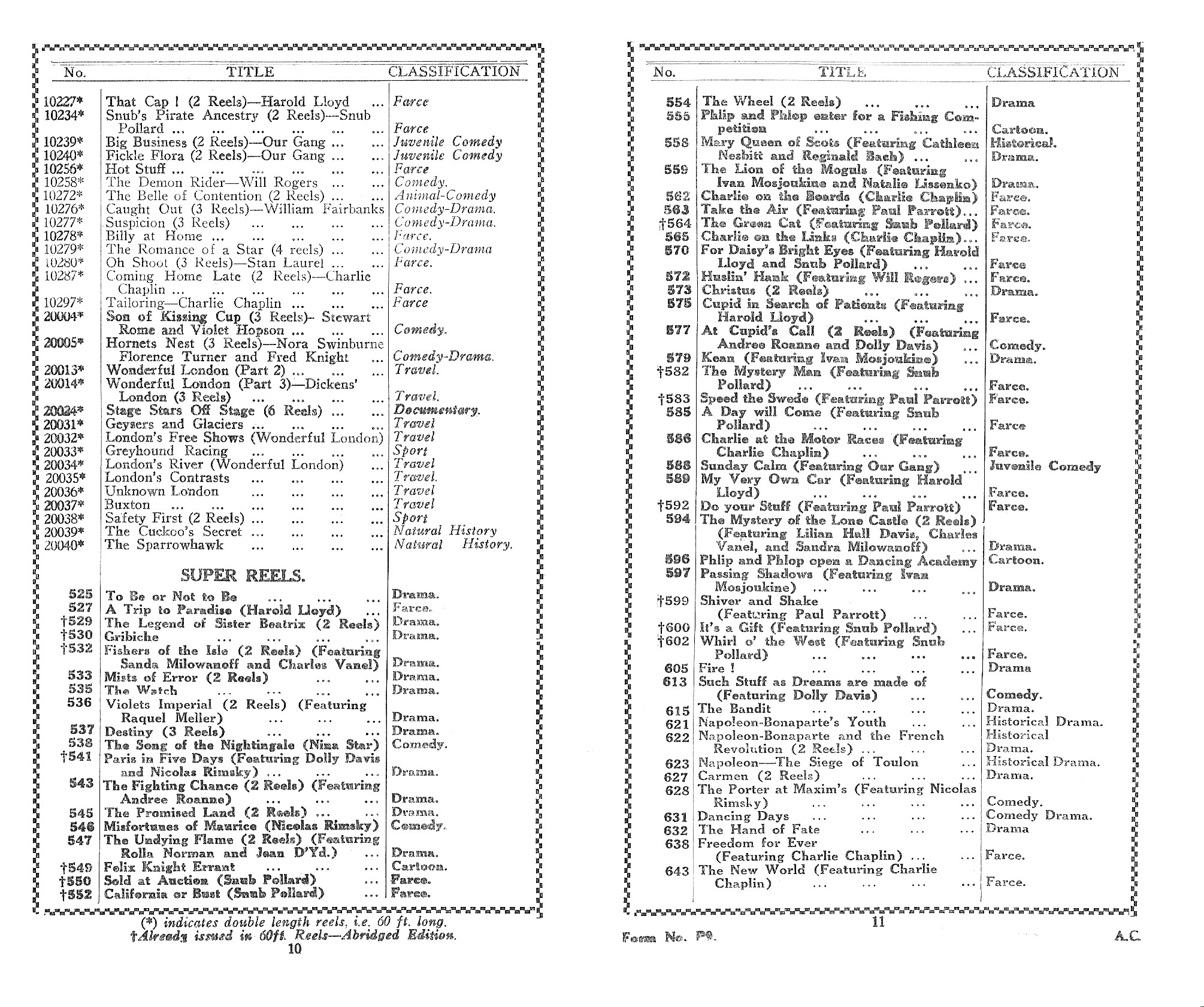
The 27th is the latest I have a record of in this series. As you can see, these catalogues were produced cheaply, obviously as giveaways, with little regard for precision on layout. The 27th I have left mostly unchanged, as it is too much work, as I know from doing all the others. I have done one to a certain level, to illustrate the change and the effect on text of digitisation and cleaning up.


Other Countries


A Spanish catlog for March 1927, from Dino Everett. It shows once again the problem of translating these analogue documents to a digital format. I have given you two versions of each page, one the raw scan as it reached me, the other with varying degrees of work. I & 2 represent hours of work each, the others only a small amount of effort. Analogue to digital actually creates artefacts in the copy which then have to be somehow removed, as well as genuine imperfections. Assuming, that is, that preservation of these documents in this way is worth the effort. At least, in this way the information can be made widely available, even if the format has defects.
Here is one from just a few months later (September), already larger.


- Details
- Parent Category: 9.5mm silent
- Category: Baby Projector
Baby Printer
BABY PRINTER
January 2015
Pathé produced a printer, based on the Baby, designed I guess for people to make a spare copy of their home movies. It was quite an elaborate affair for such a modest purpose - how many copies did you have to make to save the cost of having one done? - with what appears to be a camera mech in place of the standard mech, with the the two films running in contact on the same claw.
Willem Hackmann kindly loaned me his Baby printer so I could see all the bits that are missing from the one I got in Argenteuil. Some idiot had stripped it down and re-painted it (quite well, as it happens) but all the twiddly bits never made it back again - all the labels like Motor, Lamp, Min and Max on the resistances (which themselves were missing). Anyway, the resistances are held in place by little angle brackets of thin metal, secured by two screws. And the thread on those screws? Not the standard M3 x 0.5, oh no, but M3 x 0.6 which is of course not something you can get off the shelf. I thought for a bit I was going to have to actually make them (8!), but a considerable amount of rummaging thru my pile of odd screws ("Never throw anything away, ESPECIALLY not screws") I found enough which, if not exactly the right thread, would do the very light duty that is all that is required of them. Pathé strikes again.
Please bear in mind that these pix are all of the old style, that is, they open one at a time and must be closed by using the backspace arrow at the top left of your screen.


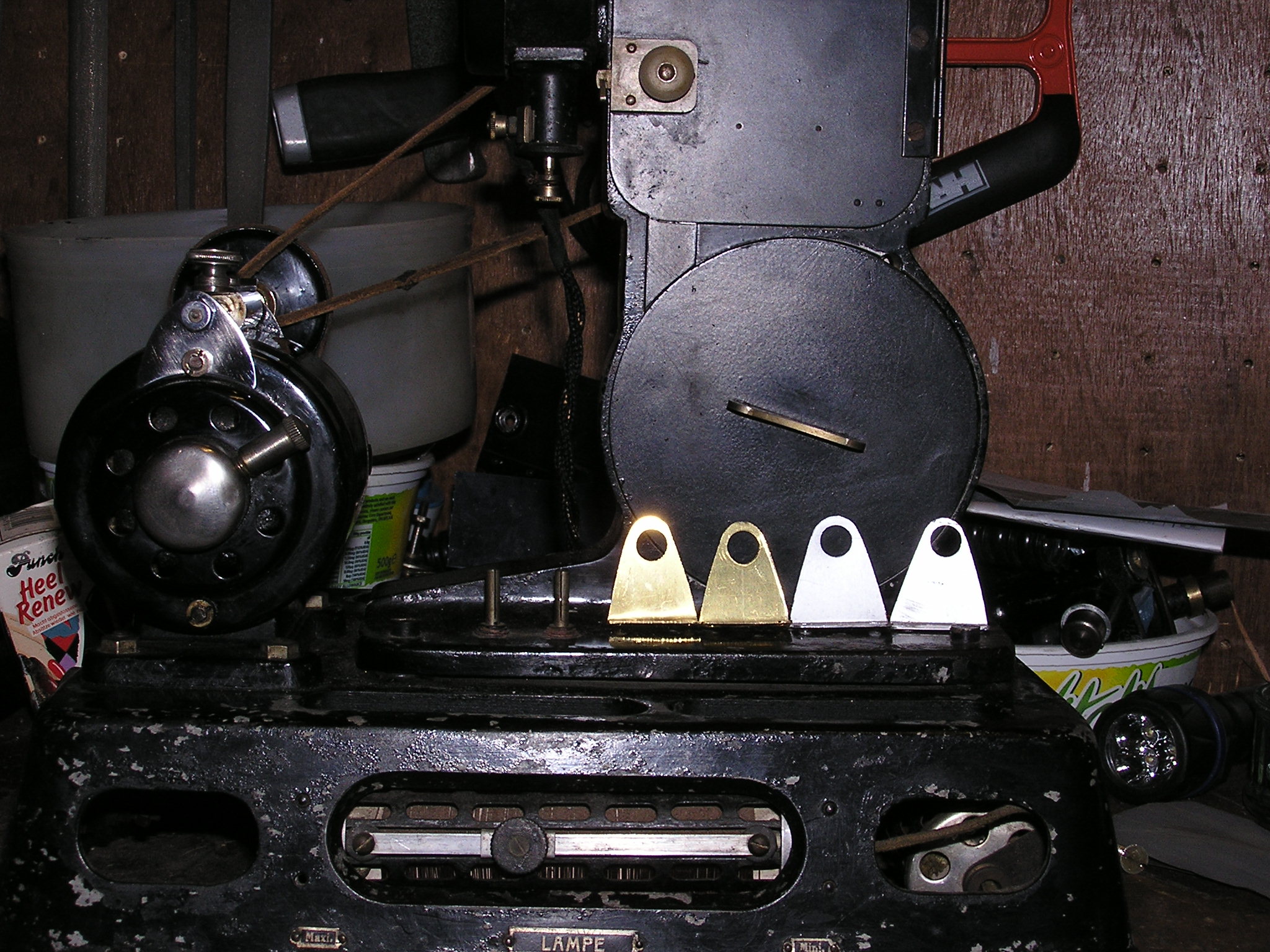
You can see in pix 2 & 8 in particular the label problem which I have, at the moment, very little idea about how to solve. I suspect this machine has been much amended - I don't think there should be quite so many resistances, or two power inputs on the top of the base. Mine is also missing the film chamber cover (pic 7), but that should be simple enough to make. The bracket for the resistances that I have been complaining about can be seen in pic 6. Pic 8 shows the neat clutch device fitted on top of the motor. Mine did not have the right motor, so I have a lot to do adapting a motor and giving it a clutch. It's a great life if you don't weaken. Wherein, of course, lies the problem. However, as I had to take the clutch apart to measure and record it so I could make one, I cleaned it at the same time to show what can be done (pic 9) and to shame Willem into cleaning up the rest. I have made some brackets for the resistances (pic 10).
Here are some pix of mine.
%20001.jpg)
%20002.jpg)
%20004.jpg)
%20005.jpg)
%20007.jpg)
%20008.jpg)
%20010.jpg)

I mentioned that mine came with a quite unsuitable motor, (see pic 7 above) not Pathé at all. I didn't have a motor with an over-the-top pulley arrangement except for an old Type "S", which is at least Pathé if not the same as the one on Willem's machine, so I used this one. I think, in fact, that the over-the-top mechanism could probably be added to any motor, but I'd started so I finished. It works fine, clutch and all.
However, you can see from the pix just how far down the machine got stripped, tho' thankfully the basic mech was left alone. I sat down and wondered whether I really wanted to do the rest (which is more cosmetic than the mechanical which is what I really like). I took the detail in pic 8 from one of my shots of Willem's machine, and tarted it up on the computer. My thinking was, narrow brass strips with holes in the right places, glue this on then a quick coat or two of lacquer and Bob is your relative. This became a trifle daunting ( I suspect I am far too perfectionist) and there are numerous 17.5 projectors waiting reproachfully at me, to name just one of the many areas I neglect when something new, interesting and preferably shiny (or shineable) like a Baby Printer comes along. Even in the last day or two, I have been working on schemes to improve sound on the converted-to-17.5 Gebescope Model A. Spring is not, one hopes, too far away, so my thoughts lightly turned to "Baby" Dave, he of the collection of every single Baby attachment etc ever produced (except the Baby Printer!) which has often featured in these pages. I still have bite marks on my hand where I did not move fast enuff when I tentatively mentioned the vague idea that maybe, in principle, I might conceivably be brought to contemplate the possibility of perhaps passing it on to him.
A little more seriously, I am increasingly thinking that I must be realistic and try, however feebly, to reduce the number of machines I have and projects that I shall never be able to complete. So I shall grit my teeth and let the Baby Printer go - at least there is overwhelming evidence it is going to a good home.
- Details
- Parent Category: 9.5mm silent
- Category: Baby Projector
Baby Equipment
BABY EQUIPMENT
There is a lot of Baby stuff - projector attachments etc - as pix of the real things, in Gear. The Baby Printer has its own page. And of course there is a lot in both the Richardson and Hackmann Collections. I have now added at the end a Marguet Rewinder which seems to go well with Baby stuff.
A French equipment catlog (courtesy Pat Moules), which I have not had time to clean up. An awful lot of the cleaning is to deal with artefacts introduced by the scanning/digitising process.


David Richardson has come up with a very early - 1926 - Pathé Baby equipment catalogue, which I have tarted up a lot, and a Baby leaflet.


Dunno date of these (Dave still).


A flyer for the camera and a colour Baby projector ad, and the sprocket feed attachment copied from another page and a motor leaflet or two.


America! And Germany!


David Richardson seems to be an unending source of rare material. Here is a catalogue issued by Pathex in America.
David Richardson has been at it again. This apparently does the same job as the cone-shaped Pathé Magnifier lens. The third pic shows a Pathexor Krauss lens, one of two better-quality lenses available for the Baby, the fourth another, the Hermagis and fifth is a special condesner lens meant to invrease picture brightness.


And this is more stuff about the water-cooled condenser set-up. It seems to have been made by a company called Mollier, and come in two versions. First was a new lamphouse to give a brighter light from a new lamp and condenser lens, tho' the voltage and wattage of the lamp seem a bit unclear. The second or "Super" version had the water-cooled jacket. Partly because it's not always clear from my knowledge or not of technical French, and partly because all we have to work on is an extract from a French equivalent of a Wallace Heaton Blue Book, everything else is less than clear, too. The text seems to imply that there is an automatic voltage reduction for still frames, to prevent heat damage to the film. However, looking at the pic shows no way this could happen and Dave can't see how either, despite having got one of them. We shall have to find more info. (But see under Babies for an experiment on this.)
