I find I have done a lot on the Bolex notching mechanism and how to make it work, so I decided this topic needed a page on its own, as Page 2.
PLEASE NOTE: All the pictures on this page are of the old type, opening one at a time and closing only with the backspace arrow at top left of the page. ONLY those with a little magnifying glass in the bottom left-hand corner of the thumbnail have their own button actually on the enlarged picture. Some of these are linked in groups.
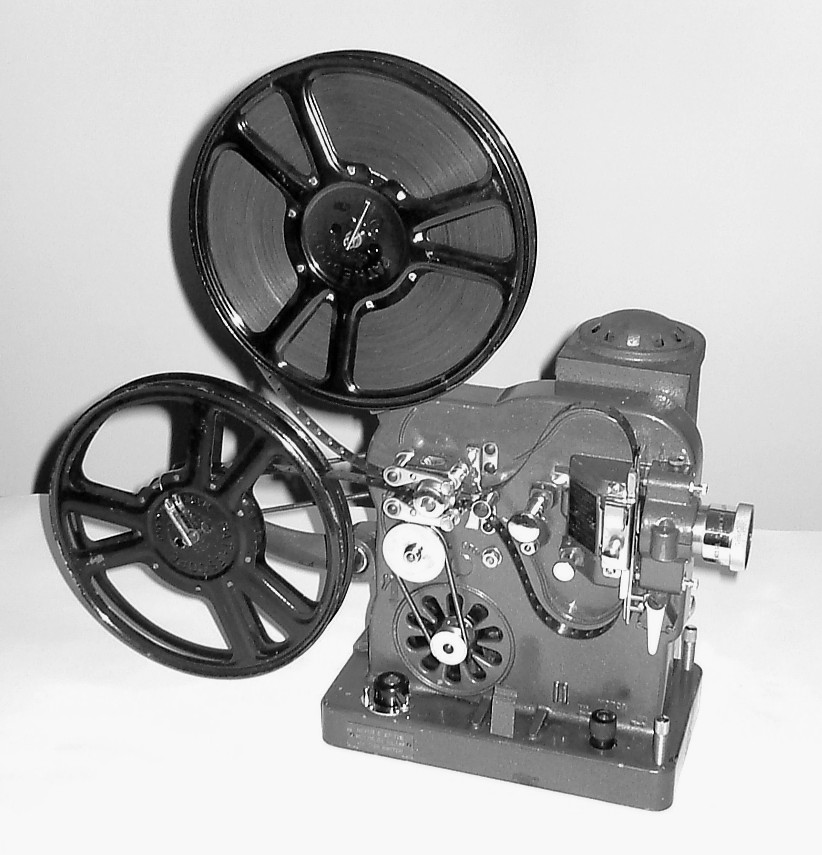
I have been fiddling with a Bolex DA that has been behaving oddly. It apparently runs for a bit, then slows down and stops. And I cannot figure out what is going wrong; everything I have tried so far simply does not work. Let me show you the notching mech, which seems to be at the root of the problem.
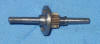


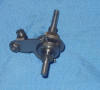

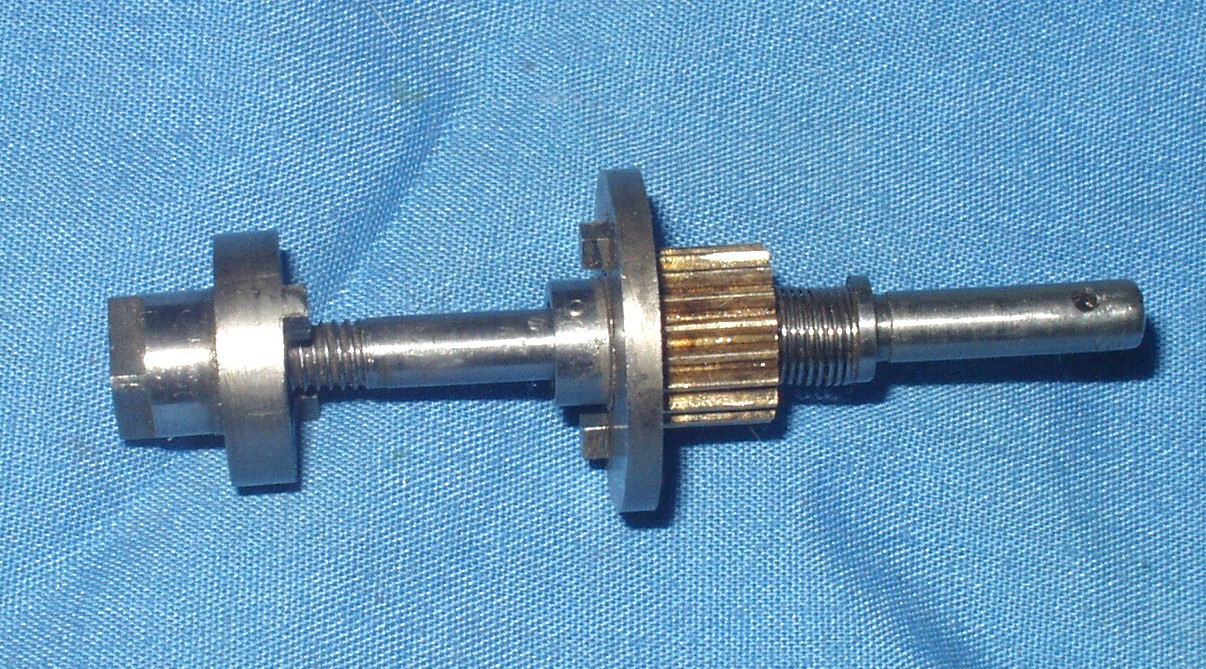
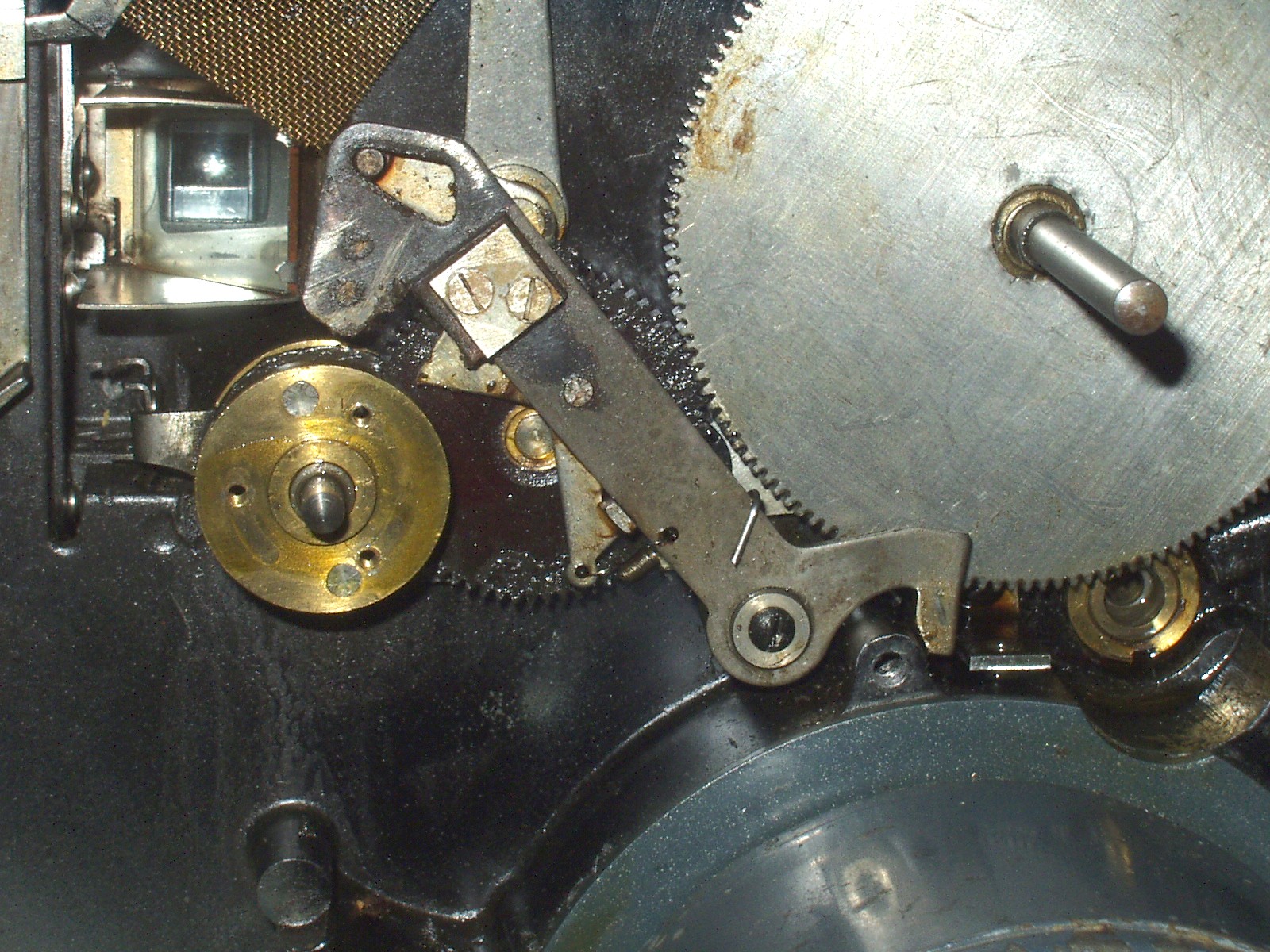
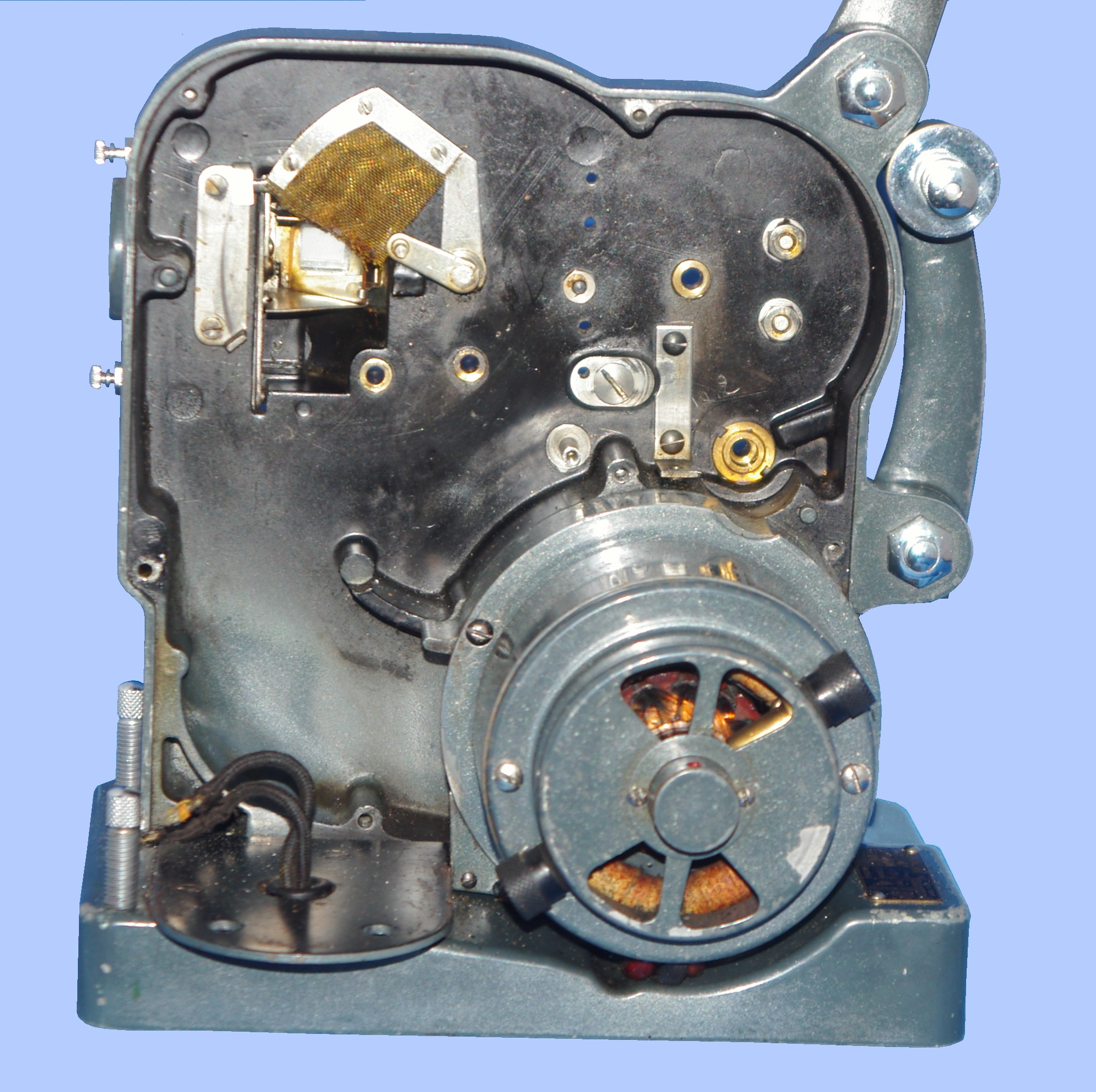
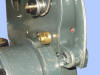
Pic one shows the heart of the notching mech; the RH end carries the pulley which takes the belt drive from the motor. Note the hole for the taper pin which fixes the pulley to the shaft. This shaft fits into the bearing hole best seen lower right in pic 7. At the RH side on the shaft is a spring held against a pinion/dog clutch assembly by a fixed collar; the pinion gear and the half dog-clutch can move a small distance to the right until the spring is completely compressed, but is prevented from moving in the opposite direction other than to allow the spring to de-compress to its "open" position The gear/clutch assembly is free to rotate on the shaft as well as move lengthways.
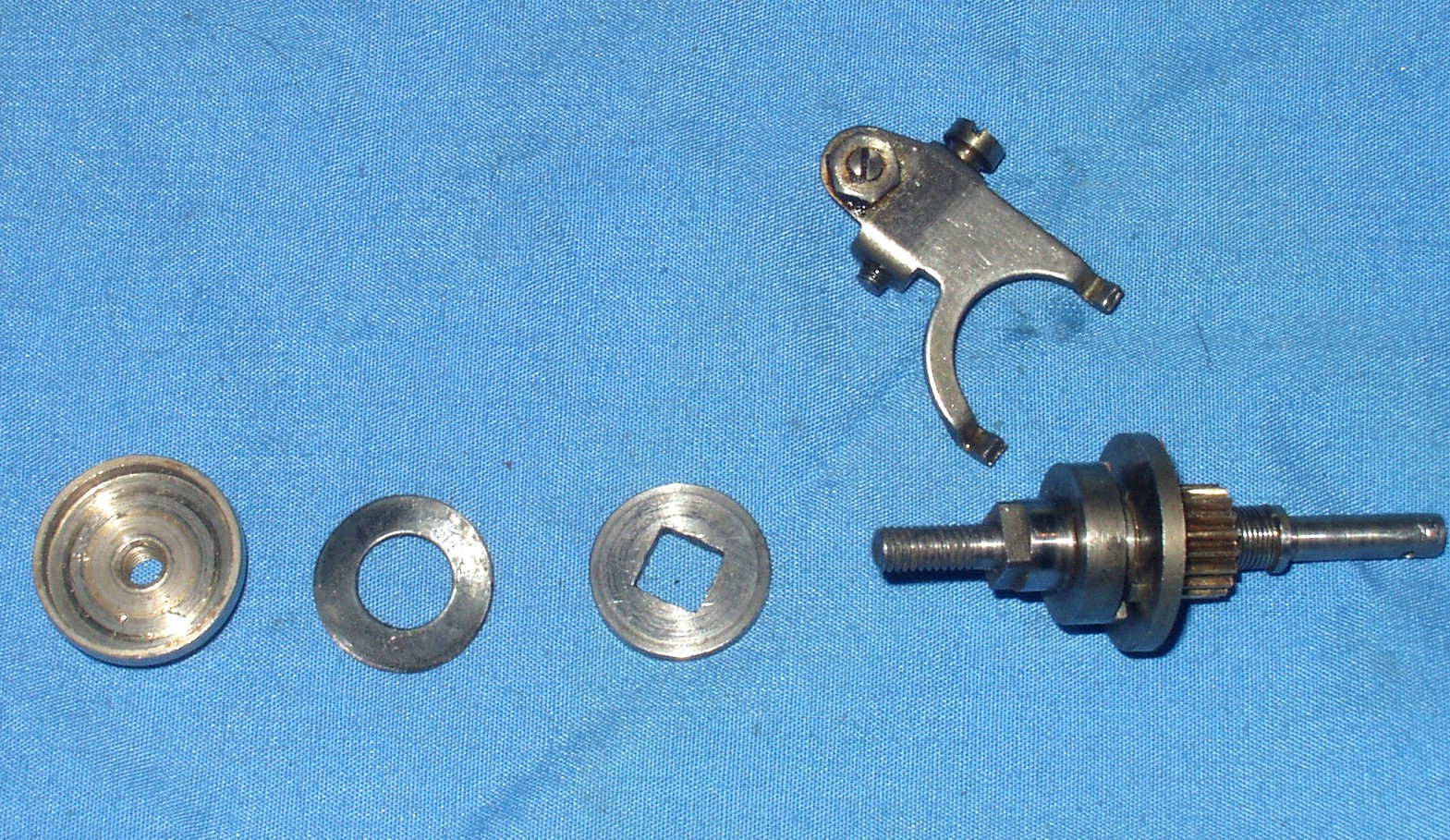
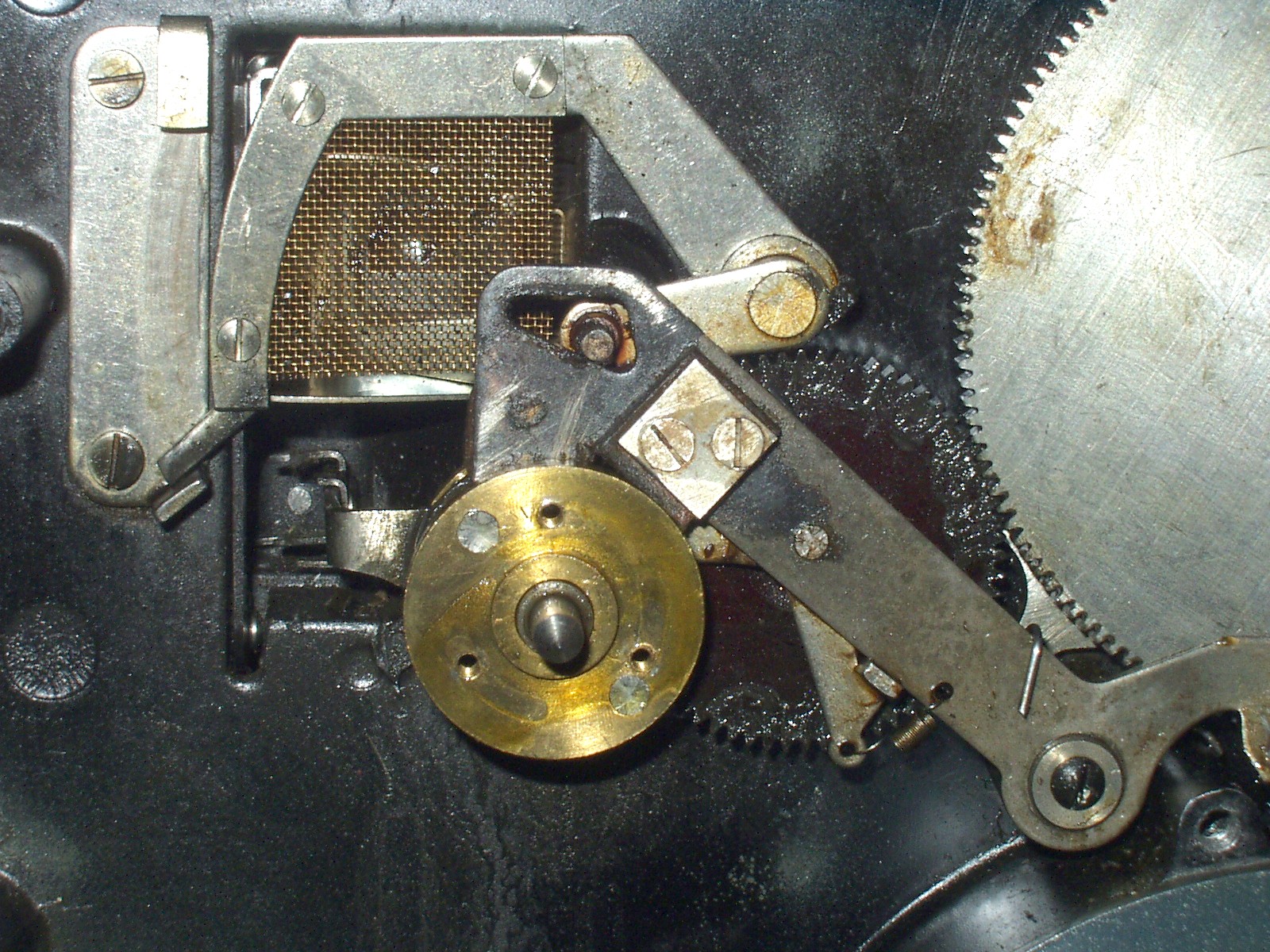
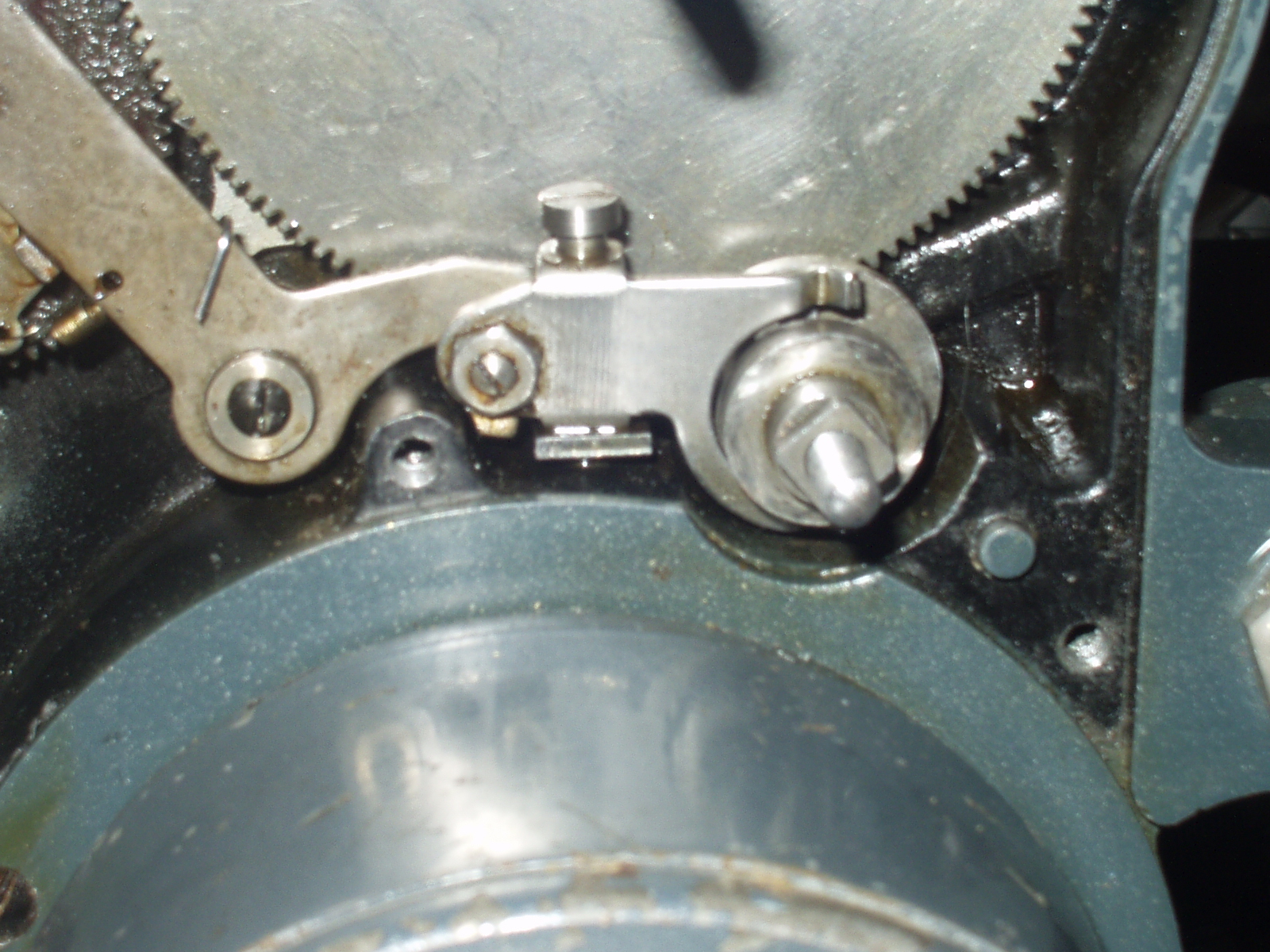
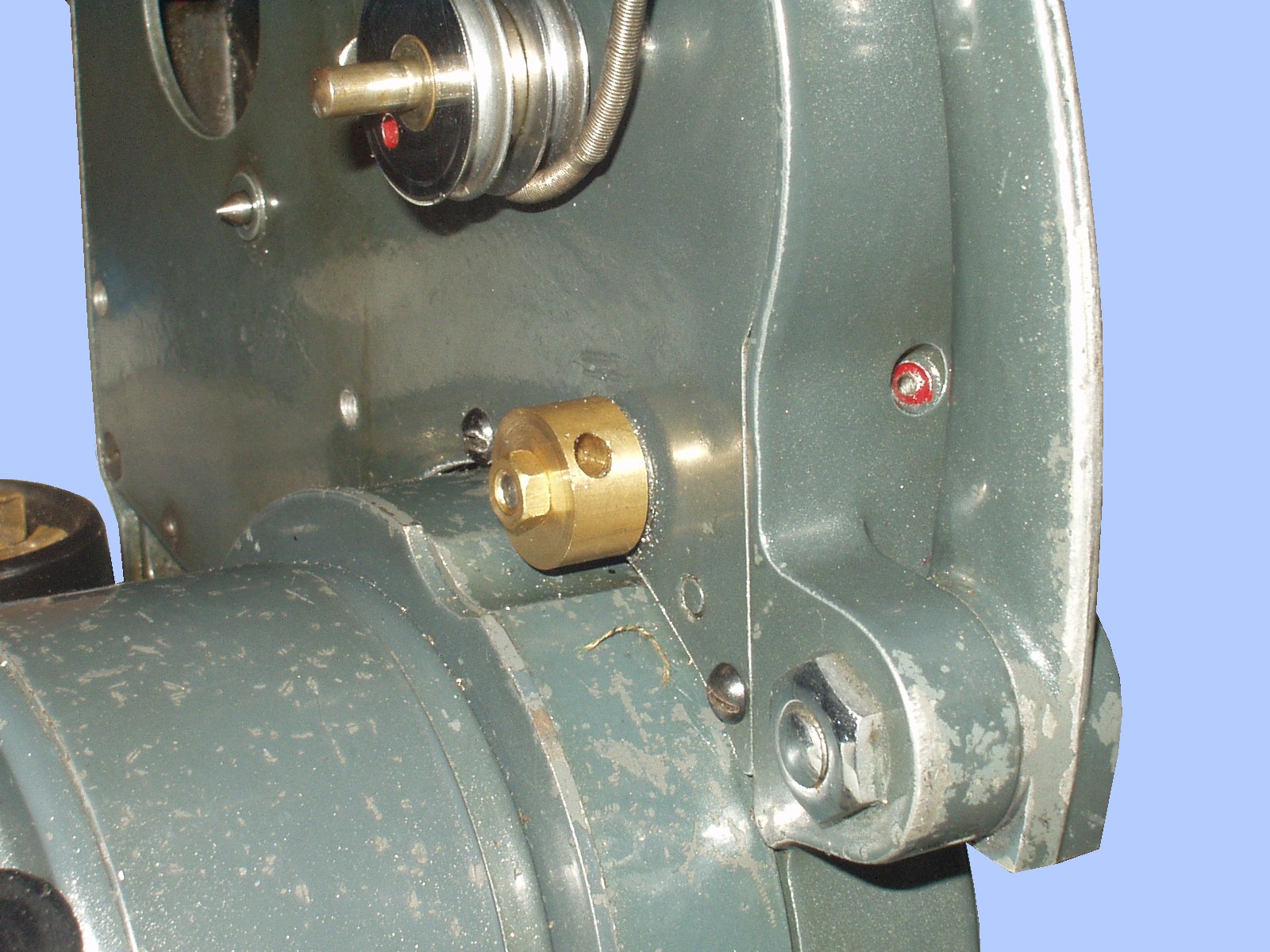
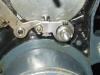
Pic 2 adds the other half of the dog-clutch. Its correct position is in full engagement with the other half of the clutch as in pic 3, but it is otherwise loose on the shaft.. The pinion/clutch assembly can move against the spring when pushed by the stirrup shown in pix 3 & 4; this dis-engages the clutch and so stops the projector. This is because the drive to the projector is from the pinion to the large gear seen in the last 3 pix. If I have explained clearly enough above, it will be seen that the pinion, being free to move on the shaft, cannot drive the big gear without some additional mechanism. Pix 3 & 5 show how this is done - this bit does my head in. A washer with a square hole fits over the square end of the LH part of the dog clutch, but only after the side cover of the machine has been replaced. A sprung washer is brought to bear on the square-holed washer by the special nut, the two sides of which are seen in pix 3 & 5- one side has a recess for the sprung washer and the other has flats for a spanner. The special nut is tightened, forcing the sprung washer into contact with the square-holed washer and is then held in place by a conventional nut, acting as a lock-nut. So, if I have this right, the drive passes from the motor to the pulley on the end of the notcher shaft. The shaft rotates, taking the lock-nut and the sprung and square-holed washers with it, so turning the outer half of the dog-clutch, which then engages with the other side of the clutch and rotates the pinion which drives the big gear. Moving the pinion against the spring dis-engages the dog-clutch and stops the mech.
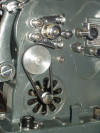
This latter part of the mech is seen in the final 3 pix. Pic 2 on the bottom row shows the notcher shaft in its bearing, with the outer half of the clutch in place. The stirrup is loosely mounted in place to show how it works. Pix 1 and 3 show the mech in, respectively, still frame and normal projection modes. When a notch activates the mech, the hammer-shaped arm is pulled down by a spring, and a brake-pad brings the shutter to a stop. The RH end of the hammer arm has a shaped portion which, as it rises in response to the other end dropping, pushes the stirrup so as to separate the two halves of the dog clutch and disengage the drive.
What seems to happen with this machine is that the special nut tightens up so much it causes the entire shaft assembly to stiffen and bind, causing the mech to stall, or else the lock-nut is loosened, the special nut unscrews and the drive is lost. What I cannot suss is why. I have tried making a new, thinner square-holed washer, adding an additional spacer between the fixed collar and the bearing, even making a new pulley secured by grub screws so I can leave some slack between the drive pulley and the mech body (can't do this with the taper pin). Also, the shaft seems to behave sometimes as tho' it is bent, making the pulley rotate eccentrically.
Another little trick it has manifested is to move the mech along in a desultory way without actually engaging fully. It has also now developed a tendency to speed up considerably for no apparent reason while running normally.
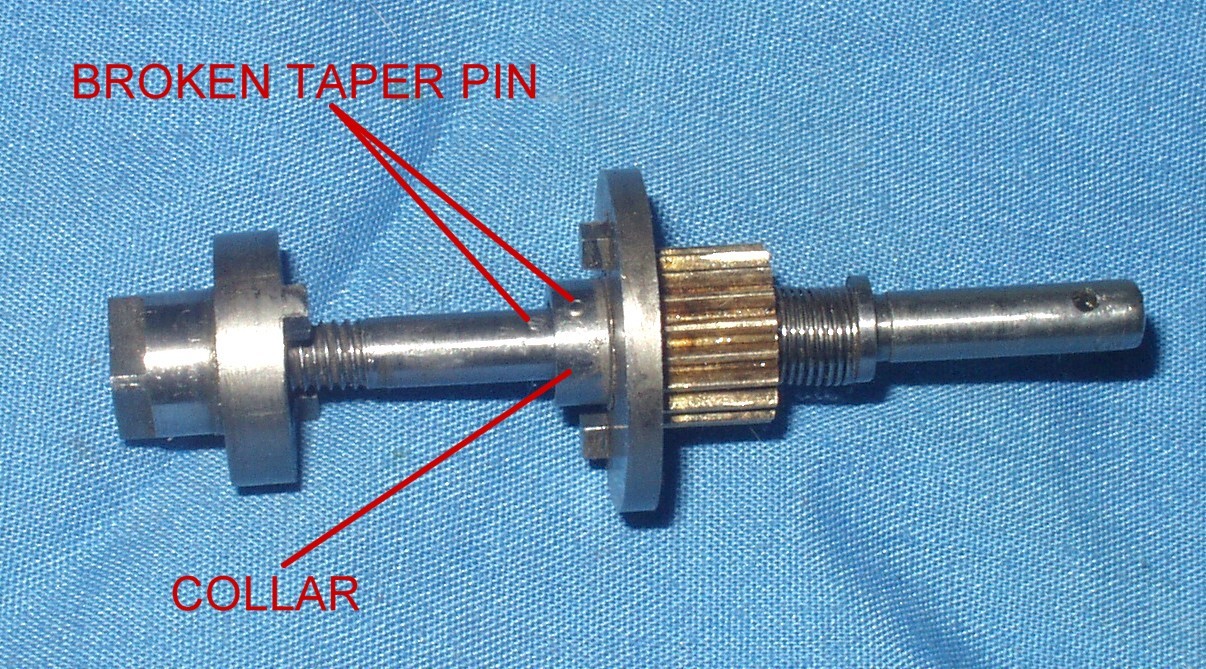
If you look again at pic 2 above, note the little collar next to the half of the clutch that includes the pinion gear. This collar limits the (leftward) travel of the pinion and clutch element. The other ( left hand) half of the clutch has a recess which fits over the collar when the clutch is engaged. When the stirrup moves the pinion back against the spring, the LH half stays still and the clutch disengages. However, I have discovered that the collar has been damaged and is no longer in the right place. If you look closely, you can see the end of the taper pin in the collar that fixes it to the shaft. However, you can also see the pin in the shaft itself - somehow the pin has been sheared right off and the collar has moved to the right. This has reduced the travel of the spring and also means that when tightening the dished special nut, it moves in too far; this may be part of the reason for the jamming problem. I am not terribly sure quite what has worked or why, but I have now ended up fitting the new pulley, the thinner square-holed washer AND a new collar with a tiny grub screw to hold it in place. This seems, for the moment, to work, tho' there is still the issue of sudden surges of speed.
I am not really sure what counsel to give to anyone facing problems with the notching mech. I think it is probably important not to over-tighten the special nut - this might be what has broken the taper pin, although I suspect some sort of blow or dropping of the machine is more likely. On the other hand, if it is not tight enough, the sprung washer will not transmit the drive to the square-holed washer. There seems to be a definite point where the special nut reaches a "stop"; this may or may not be something to do with the length of the screw thread at the LH end of the shaft and the smooth section that follows. It also seems to me - I have a second DA on the bench, too - that there are differences of detail between machines - the second has a much stronger spring on the notching shaft.
Sorry not to be more definite - if anyone has anything they can add, I'd be glad to hear it.


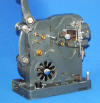
These pix show my new special nut and pulley on the second DA, plus pix of how these machines should really look. Note my pulley is slightly larger than the original, not for any particular reason. The special nut is somewhat smaller in diameter. I made it this way as I had a piece of brass about the right size and with that hole that passes thru the side of the nut without touching the central bore. This enables me to use a tommy bar thru the hole rather than a second spanner. I have found that the tightening of the special nut and locknut is both critical and difficult. It should NOT be done with a pair of pliers. You need 2 spanners, but one at least needs to be quite thin. If it ent, it will overlap onto the other nut and interfere with the locking. My new version does away with this problem. But it is essential to tighten the special nut by hand only; it should reach a definite stop and should be finger-tightened against this. When adding the lock-nut, do not allow the special nut to move; let the lock-nut do all the work. One snag I have found is that the sprung washer has an oversize bore and can protrude outside the special nut and get jammed against the square-holed washer. If this happens, the set-up won't work. Another point to watch in re-assembly is the pivot bolt which holds the stirrup. The bolt is only threaded right at the bottom, with the smooth section passing thru "brackets" at the top AND the bottom of the stirrup. It is regrettably easy to tighten the bolt without ensuring it has passed thru the lower bracket properly, or to get the bolt cross-threaded. If the bolt is anything other than free-turning until fully seated, it may indicate cross-threading, which could do serious damage to the mech.
One of the trickiest parts of re-assembly is the torsion spring, see pic left. Look at the pivot just under LH side of the big gear and immediately above the motor case. One end of the spring is just visible above the pivot, the other end rests on the raised bit of casting immediately to the right. Trouble is, it has to be given a lot of twist to get this second end in place, at the same time as pushing the arm into place. Very fiddly. The spring is wrapped round a large spacer which is part of the pivot, and can be seen in the centre pic below. This spring seems able to get one of its coils between the end of the spacer and the machine, preventing the pivot arm from bedding in correctly - the screw tightens but locks the pivot solid until you can find a way to get the stray coil onto the spacer where it belongs. As you can see, it's actually pretty difficult to see to do this.
May 2014
I might, just might, have found a solution to the problems covered above with the notching mechanism.
I have been wrestling on and off for an age with a problem afflicting certain Bolex DA machines belonging to me and various friends. What happens is that, while the notching mech works fine with the side off, add the side and the mech jams, or fails to turn, or turns very slowly and lackadaisically with no real
force or conviction. I have formed a theory that, for reasons unknown, wear or some other problem has caused the side plate to interfere with the correct operation of the notching mech. The tricky bit required testing of the theory by making a copy of part of the mech with part of it extended so as to move it well clear of the side plate. The part in question is shown in this pic; the section I have made longer is marked in red. This part is one half of a dog clutch; in use it actually sits up against the ring, fixed to the shaft with a thru pin, that you can see just in front of the other part of the dog clutch. It is this latter part that moves, against the spring you can see, to operate the notching mech. The part I have copied rotates but does not move to and fro once set in place. Anyway, it seems to work, but I am sending the new part to a friend to test further.
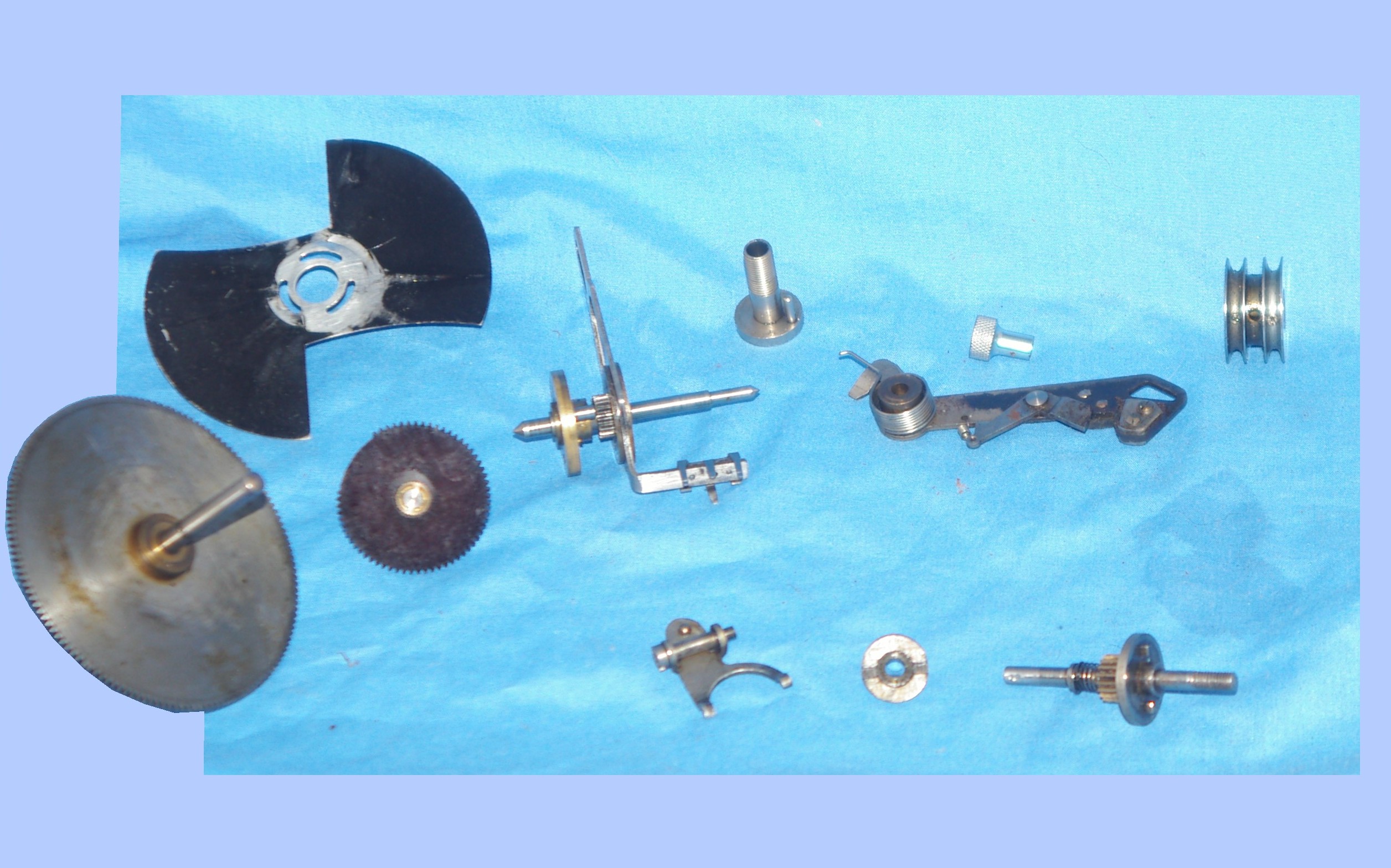
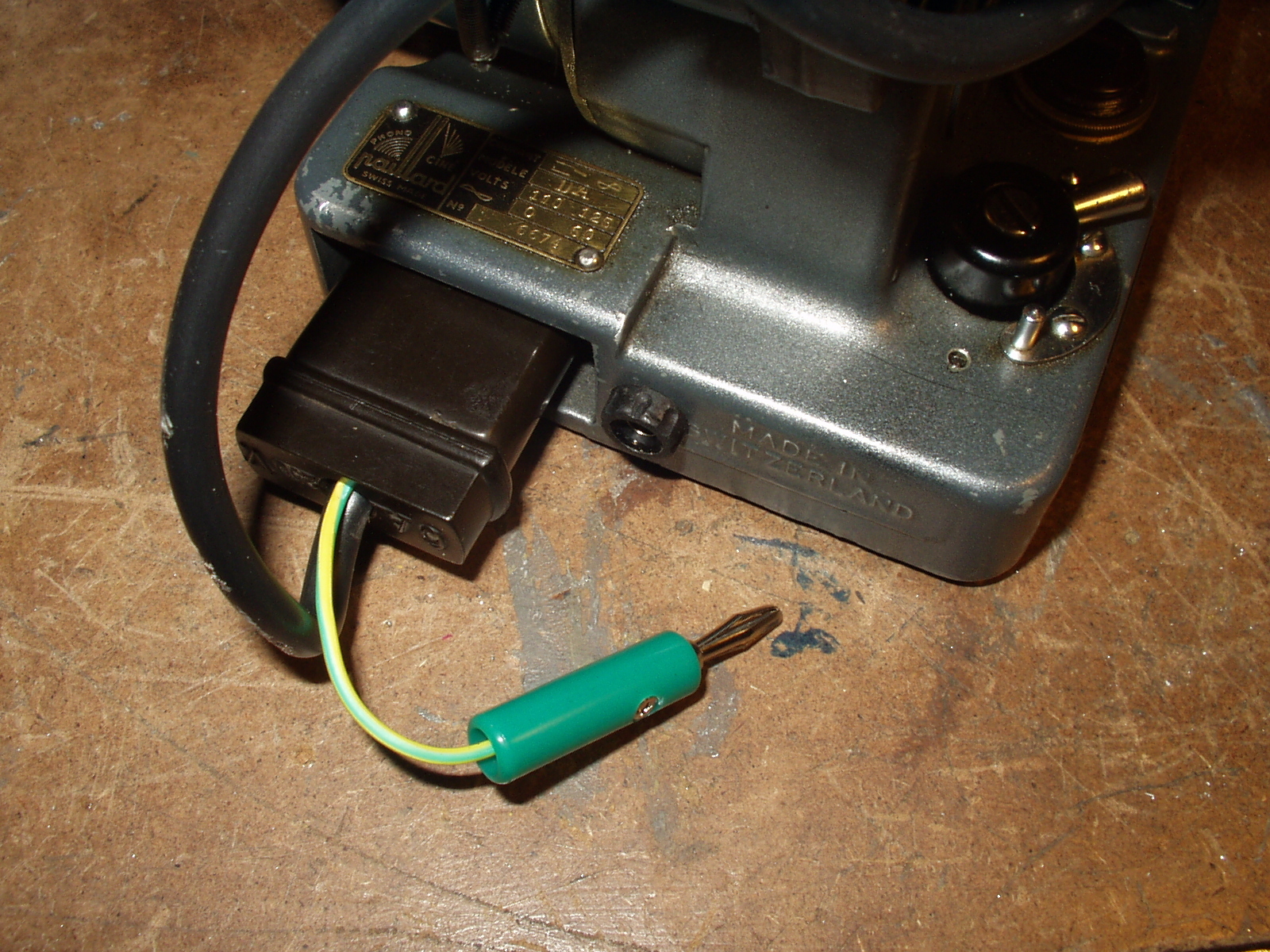
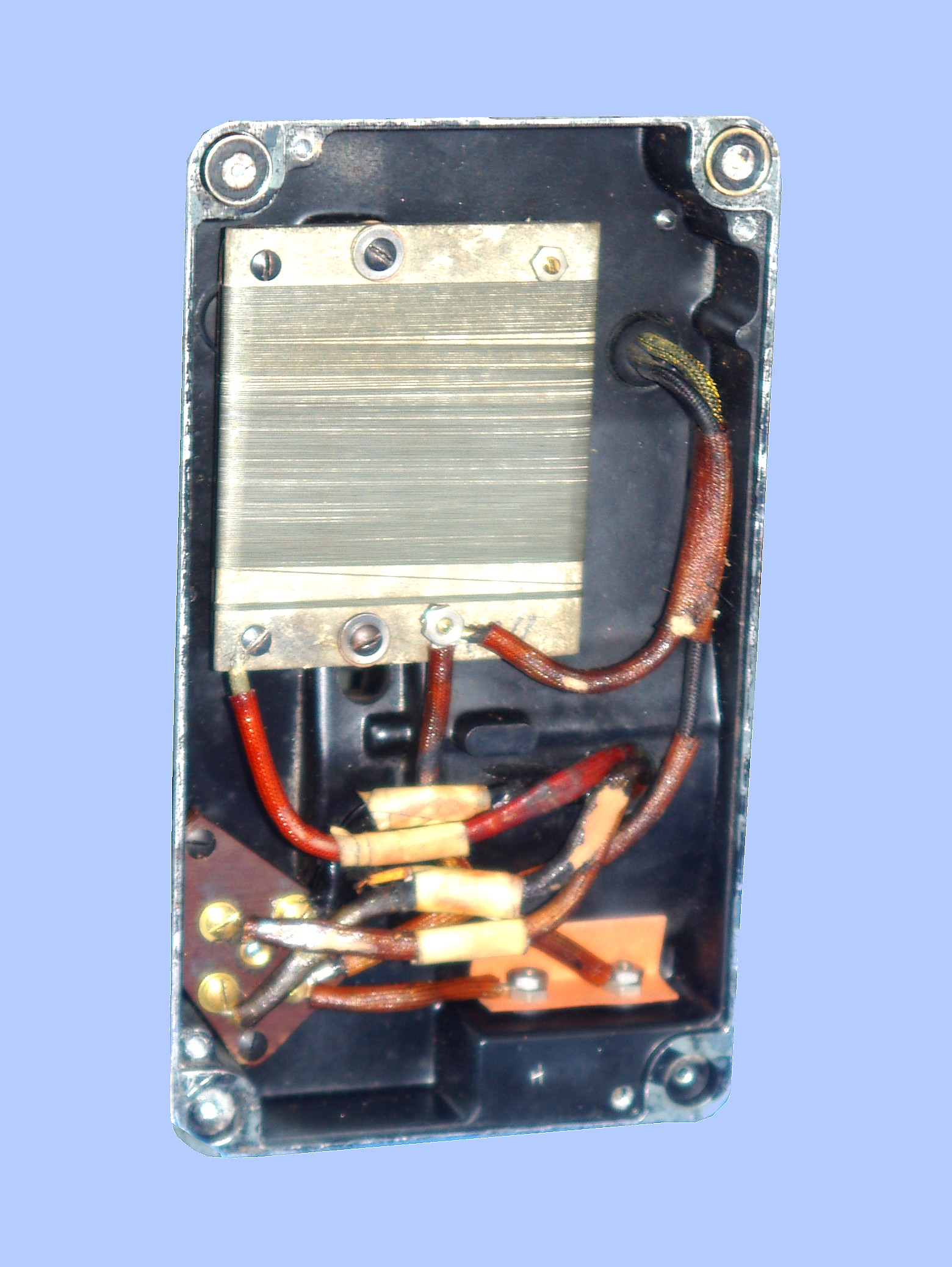
Here are some additional pix of the machine stripped down and parts, plus an earth I fitted to one machine - a rare case where I think changing the original discreetly is justifiable - and an underside view.


-------------------------------------------------
Yet more on the weird problems of the Bolex DA. A key part of the mechanism is shown here - it is the main drive shaft running from the pulley at the front of the machine which is driven by the motor, to the outer end at the back where the square washer etc fit.
The pic shows a broken one. What there should be is a collar like the one shown, ie a round thing like a donut, only about 3.2mm or so wide, which is fixed to the shaft by a pin that passes thru the collar, then the shaft and then into the collar again on the other side. Imagine the broken bits as shown all lining up, unbroken. It stops the part with the gear from moving too far to the left, and it stops the other half of the dog clutch, ie like the bit I made a copy of, moving more and more to the right and squashing the spring behind the gear so much that it starts to seize up the mech. And the collar has to fit within recesses in the 2 halves of the dog clutch (or maybe only 1 recess cant recall). If you extract this assembly from one of your machines all will become miraculously clear. I skirted around this idea before (see highlighted text a bit further up this page).
I increasingly think this is the root of all evil. The last busted machine I had was like this, I fixed it and lo! no problems!
---------------------------------------------------------------------------------------------------------------
I have had an enquiry from someone with a got-at Bolex DA who (brave man) is planning to make a new shaft for the clutch mech. I took a few pix and did some measuring, which I may as well add here.


The first row reinforces the importance of the small collar against which the spring holds the combination gear and dog clutch. This is held in place by a pin thru both sides of the collar via a hole in the shaft. It appears this pin is easily broken by over-tightening the external fixing. This arises essentially from a minor design flaw. To explain this. here are a couple of pix you may have seen before.


The fundamental basis of the notching mechanism is a dog clutch, the two halves of which can be seen in pic 1 above. The inner half is fixed to a gear, but both halves are free to rotate on the shaft. When a notch passes thru the gate, the stirrup seen top in pic 2 and in situ in pic 3 pushes the inner end of the dog-clutch against the spring and so out of engagement with the outer half. This cannot follow because it is stopped by the collar secured by a pin. In pic 5 of the top row you can see this pin protruding - infact, it can't do this in use as it would foul the dog clutch, so it has to be a flush fit.
The outer part of the dog clutch has a square end which protrudes thru the back plate of the machine, and is then fitted with the square-centre washer seen in pix 2 and 4 above. Continuing to work outwards, next comes a spring washer (second from right in pic 4 above). This is a bit dished in shape so that when compressed it grips. This washer fits inside the dished cover (3rd from right in pic 4 and 1st left in pic 2, showing the two different sides). As can be seen in pic 4, this cover has two flats on its outer end, to assist in locknutting it against the final nut (left in pic 4). I think it is this process of locknutting that causes the problem - I am sure many people try to do it without two spanners, one of which needs to be unusually thin. Either the dished cover is over-tightened in the first place or during a bodged attempt at locknutting, which forces it up against the collar. Given that the dished cover is on a fairly fine thread, it can deliver a considerable force for relatively little effort, enabling it to break the pin. The entire thing is then disabled and at worse can cause the mech to jam up completely.