Pathé Baby
BABIES
This was one of my earliest web pages and has long been in need of updating. I have now divided everything about Babies into a range of separate pages, leaving this page for just a few odd Babies and related stuff, and to guide you to the various Baby pages.


Pathé introduced the Baby projector in 1922; this is an early publicity shot. It went on to develop a wide range of accessories, add-ons, attachments and gizmo's, plus a range of attractively-packed ancillary items. It was the birth of the "gear" hobby in cine - the only way Pathé could continue to make money was to sell you more and more bits and pieces, and you can see some of this paraphernalia on the Gear page. David Richardson has specialised in collecting and restoring all possible variants of the Baby and its attachments, so I have set up a page just for his stuff - The Richardson Collection. Another avid collector is Willem Hackman. I recently had the opportunity to take pix of his collection of Babies, so I have given him his own page, too - The Hackman Collection. In the tradition of those old "Glamour" films is a "What the Butler Saw" version of a Baby. Other Baby-relevant pages are Baby Equipment, mainly concerned with equipment catalogues (but with a separate page on the Baby Printer), and Baby Film Catalogues, which do what it says on the tin. Before Pathescope Monthly was introduced, there was a series of leaflets initially called Baby Cine Chat.
Finally, a separate page devoted to Pathé Baby in America, where the brand name Pathex was used. Pathex was particularly notable for introducing, only briefly, alas, 9.5 sound-on-disc.
You will also find information about Babies in Gerald McKee's Classic Home Movie Projectors. You will find under French Bits a series of articles about Pathé Baby films. For a late and rather odd successor to the Baby, see the Coq D'Or. And finally an attempt to cash in on the Baby name with a Pax-style projector in the 1950's.


As we all know, the biggest problem with Babies is the shutter distorting and breaking. Up to now, nerds have always believed that it was necessary to replace the shutter on a like-for-like basis, but I asked myself why? It's not visible, and if, as most do, the Baby has a motor, the flywheel effect is not needed. So I have invented the Stevens Patent Disc Shutter, aa shown above. This is a rough version, which don't got the various blades in exactly the right place, but it shows the idea.
Improving Light Output from a Baby
There have been quite a few expedients adopted to try to improve light output from the Pathé Baby projector. Better lamp, improved condenser lens and improved projection lens were the simple ones. Then came the extra bright lamphouse, with an altogether more powerful lamp and a much bigger condenser. There was even a water-jacketed version of this. One problem with all this is that, so far, no written instructions have come to hand, so the following may be subject to correction.


 \
\
First we see the basic enlarged lamphouse. It simply fits in place of the original lamphouse back cover, the extra weight being supported by a highly-sophisticated (not) bit of spring with a fitment on it to go over the knurled knob that secures the lamphouse top. Next is the water-cooled version, which is in two parts. The condenser is in the section with the water connectors showing; it seems to be this that is cooled rather than the lamp in the back section. Nor does it appear that the water flowed thru; it just sat there, so far as we can tell. There is no visible means of support here; there appears to have been a version with a sort of platform which fitted to the projector to act as a support, shown in the catalogue illustration. These three are all from the existing Richardson Collection page on this site.
The last picture here is from the site www.fondation-jeromeseydoux-pathe.com. I was just going to put a link, but the link to the page with this pic was so long it seemed daft. There are plenty more pix to see on the site. But just look at that resistance!
The problem with these, however, was that there was the obvious risk of burning the film when the mech stopped for a notch. The solution to this was found in the shape of an attachment that automatically dimmed the light at each notch. The best image of this we (ie David Richardson, who keeps finding these fascinating catalogue entries) have is quite poor, but for what it's worth, here it is, although it does at least tell us the lamp is 8v 3 amp. With imagination, one can also see the resistance is like the one in the Jérome Séydoux pic above.

The only logical solution to how this might be done had to involve the notching mechanism itself. Just in order to prove it could be done, I made a quick lash-up from odd bits. This actually cuts the circuit when the film is running; it would probably need to be the other way round in practice (ie make rather than break the circuit), but I had this little contact unit..... But you can imagine a circuit where breaking it at this point would force the power supply thru a dropper resistance and so achieve the desired effect. Incidentally, a pic 2m across with an audience of 100 is claimed.
If watts = volts x amps, 8v 4a is still only 24w! (And let's not forget the Lodex Lamphouse, which seems to have had a 50w lamp - see further down this page).

The device is basically a plate which takes the place of the little cover over the slider for the notching mechanism. It is held in place by the original screw and by "wedging" up against the edge of the gate moulding. In this version, the paxolin block is free-floating, riding on the screw and held by the folded "bracket" formed from the base plate. The paxolin block has a groove for the notching lever, which also helps to hold it in place, and a tongue to separate the two contact strips when the film pushes the slider out of the side of the gate. It worked quite readily, so obviously it would be possible to control the power of the lamp like this. One might use a micro-switch, for example, instead of contacts, and maybe a relay at the transformer/resistance end to limit the current passing thru the switch arrangement.
LATER
Dave Richardson has found instructions showing how the operation of a bigger lamphouse for a Pathé Baby projector could give more light but still not burn the film. When I finally worked my way thru the French (of course) instructions, I was gratified to note that what we had conjectured earlier, when we had no detailed knowledge of the thing, was pretty accurate. As part of my normal service to benighted monoglots, I have translated the instructions for you and done a few extra pix to help. As in the lash-up I made some time ago, the device relies on the movement of the slider that enters the notches in the side of the film.


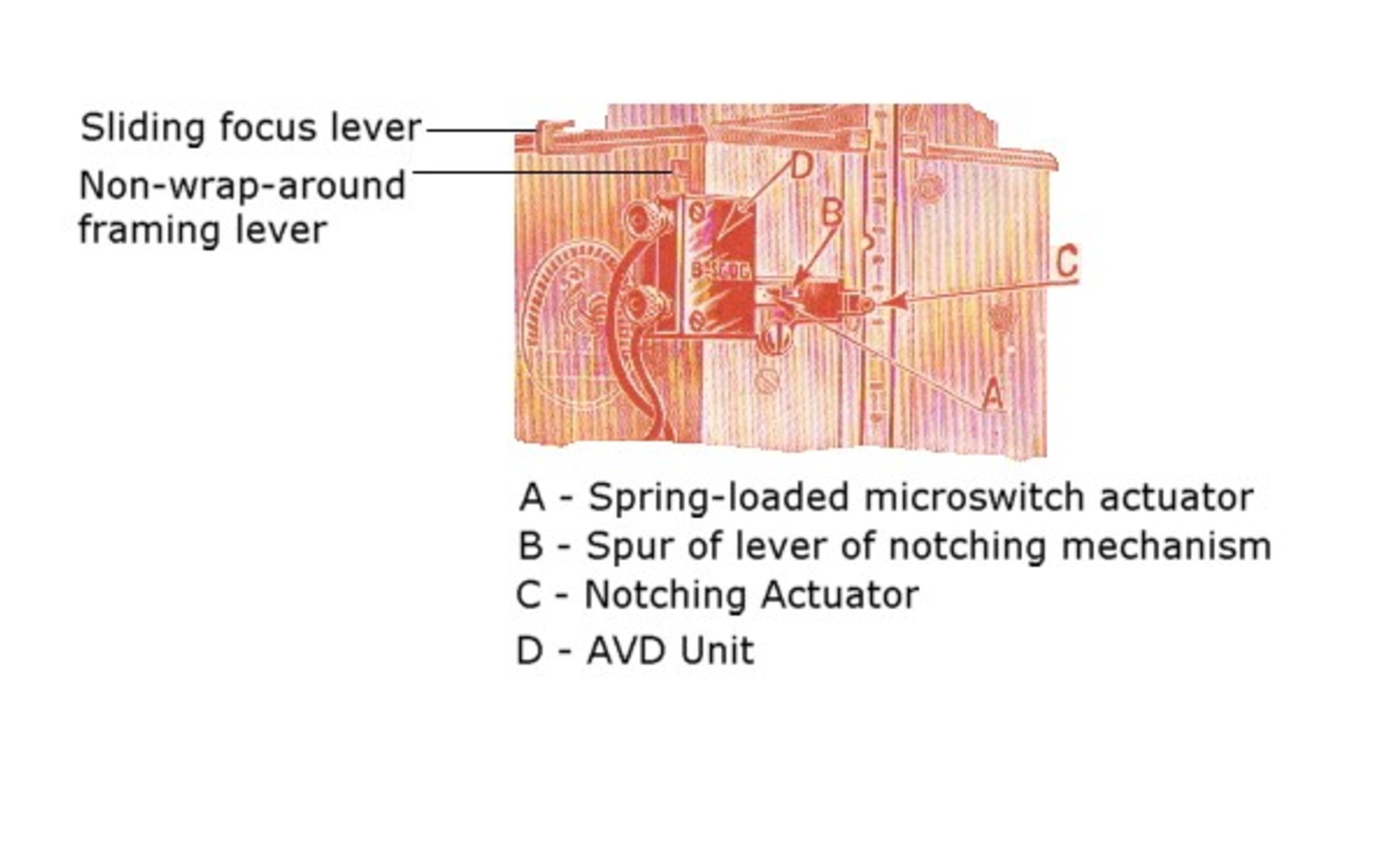


First, the actual document - very hard to scan to a decent quality, then a close-up view of the lamphouse. 3rd is the device itself, then a pic of a partially dismantled Baby notching mech to show the key parts involved. The slider, or notching actuator, slides freely in its slot on the rear face of the mech, but is held in place by the cover plate seen above it in pic 4. It has a slot which fits over the protruding end of the notching lever. The only reason I can think of for the existence of the spur on the end of the lever is to enable one to hold the notching slider back whilst inserting film into the gate.) These two vital parts are shown in close-up in pic 5. Finally, a plan view (Pic 6) shows the lever in position on its pivot bolt and the torsion spring which drives the slider into the notch when one comes along. This pic also shows the lip at the side of the mech casing which the Auto Voltage Dropper (AVD) uses to secure itself to the machine.)
The little AVD unit is basically just a microswitch that uses the spur on the notching lever. (Given the small size of the torsion spring on the pivot bolt, the microswitch must be very sensitive and loosely sprung or there wouldn't be enuff force to operate it!). As the slider gets pushed back after a title, the spur pushes the switch pin to close, (or open, I am not sure which), a contact and Hey Presto!
Anyway, here are the (freely) translated instructions, which refer to the images in pic 1 above (I have done a translation of one part in pic 3).
<< The SUPERLITE, i.e. the MOLLIER AUTOMATIC VOLTAGE DROPPER fitted to the Pathé Baby projector, comprises a mechanism that increases the lamp voltage for normal projection and reduces the voltage for still frames. In this way, the film cannot be damaged by heat when the projector automatically stops for titles. This mechanism allows the use, without any risk, of a lamp that is far more powerful than normal, and permits high-brightness pictures up to 2m wide with the standard lens and 2.5 meters with the Hermagis lens.
Thanks to the Superlite, all owners of the Baby Camera can readily show their own films, which are often far denser in tone than commercial printed films and the projector can be used for meetings, societies and clubs since a screen image 2.5m wide can cater for an audience of 100. This is particularly valuable in the education sphere where use of the Baby Projector was hitherto difficult because of the small picture size.
DESCRIPTION AND INSTRUCTIONS
The Superlite comprises three main components.
1 the Lamphouse; 2 the Automatic Voltage Dropper (AVD); 3 the Resistance.
Fitting is very straightforward and can be carried out, even by a child, in a few moments without any change to the machine or drilling any holes.
Heres how to install the Superlite:
1 THE LAMPHOUSE
After removing the rear of the Baby Projector lamphouse, remove the condenser lens by pushing it towards you. Fit the Superlite lamphouse by sliding it onto the remaining front part of the original lamphouse. Push home firmly and tighten the locking screw. Place the cap on the end of the spring attached to the Superlite over the knurled knob on top of the projector.
2 THE AUTOMATIC VOLTAGE DROPPER (AVD)
The AVD unit (D) houses a small switch mechanism to close an electrical circuit in response to the movement of the notching device when it is triggered by a notch in the film. To fit the unit to the projector, loosen the two screws 5 mounted on the clamp 1 and place the unit over the lip 2 of the projector, so that the small lever 3 (also A) just touches the spur 4 (also B) of the notching device. Now re-tighten the screws to hold the unit firmly in place.
3 RESISTANCE
Once the lamphouse and AVD unit are in place, ensure that the cursor 10 is pushed against its stop 11 (this stop should never be moved). Attach the plug 6 on the lead from the lamphouse to the socket 9 of the resistance and the socket 7 from the AVD unit to the plug 8 of the resistance.
The apparatus is now ready for use.
Thread the film, connect the resistance mains plug to a light socket and crank the projector handle without stopping until the end of the film.
To stop the projector at any desired place in the film, return the cursor 10 of the resistance to Its lowest setting, so as to reduce the lamp voltage, as the automatic mechanism only works when the projector stops at a notch in the film.
To check the operation of the system, leave the projector gate open and push the pin 13 of the notching device with your finger; you should see the light level increase then fall back once more when the pin 13 is released. >>
I have been thinking about the practical implications and ramifications of all this. On the face of it, this seems to be at least as good an idea as having a heat shutter come into play, as in the Bolex DA, and it could in principle be applied to any machine if you could find a way of connecting something to the notching mech - and with modern electronics that should surely be possible. One possible downside is the heat from the lamp. As you will all have seen, when a lamp is switched off there are a few moments of fade before the light - and presumably the radiated heat - are gone. With just a reduction in voltage, there might well be enough carry-over of heat to cause problems, so there may be limits on what can be done on machines that don't have the heat filter, quite apart from the problem of cooling a more powerful lamp. However, I would guess that it would enable a Lux to operate with one of the higher power lamps like the S and leave the titles safe.
My Bolex PA has been converted to 900' arms and a 15v 150w dichroic mirror lamp. I found at first that the titles did in fact start to buckle, despite the heat filter, and I had to "de-focus" the lamp a bit. Now if I fitted a switching mech like the AVD to work alongside the heat filter, I could really go to town on the lighting........ Then all I need is an automatic mech to restart the machine after titles. And a more powerful fan.
-----------------------------------------------------------
I have developed a lampholder for Babies, which does not require any alteration to the machine. Click on the link for details.
----------------------------------------------------------


These are some close-up views of a sound Baby. It is, I believe, the one written up in ACW after the war, although further modified. The real guts of it are in that copper-coloured thing in front of the former take-up chamber. The film emerges from the gate, makes a very tight and peculiar loop and runs under a flap on top of the copper thing, where the track is read.
The rest of the gubbins is about trying to smooth the pull thru of the film. When I saw it, the owner had mislaid the instructions and I don't think it was running right. Nonetheless, it produced sound and, what was remarkable, the mechanism ran like a sewing machine, purring along quietly. I don't suppose it is very kind to films, but it does show how good the original basic mech must have been. You ask why on earth should anyone want to do it. You might just as well ask why men climb mountains. And as a piece of cine history and a simply beautiful-looking piece of engineering, it is worthy of any true nerd's attention.
---------------------------------------------------------------------------------------------------------
How's about this for the answer to the nerd's prayer? Sprockets for the sprocketless! I wonder why it never caught on? I cannot see quite how the drive from the projector got to the sprockets or if it handled notched films.

-------------------------------------------------------------------------------


Here are some pix of a strange baby. Someone seems to have made a very pro job of fitting a giant lamphouse, with a chrome back that seems to have been specially made, as it has a rim. But it's very shallow, the socket on the back points outward and the whole thing seems to have failed actually to achieve anything. (Memo to self; consider fitting vertical Xenon lamp.) Last pic is unconnected - a plug-in voltmeter labelled PathBaby, courtesy Colin Loffler.
How's about a Giant Baby? Spotted on French eBay by Dave Richardson. It seems to be a prototype that never went further. It also has a special lamphouse with bigger condenser and more powerful lamp; this was an attachment available for the normal-size Baby.


Lodex Lamphouse


There were more conventional ways of getting more light. Lodex seemed to specialise in add-on bits; their Baby lamphouse used a 10v 5 amp lamp (I have seen exciter lamps of this description). A small mechanical fan was driven by a belt from a doubled-up pulley on the main drive shaft. I passed one on to The Hackman Collection.
I have a number of decrepit Babies and add-ons. Here are the results of a re-spray of the worst bits. The lamphouse is sprayed with heat-resisting paint - the reason these are nearly always rusty is heat damage to the original paint. The other parts are sprayed with smooth Hammerite, covering parts as necessary with masking tape.


I had a slightly bizarre set of issues with a Baby I was working on for a friend. I had seen this machine before, but it now had new problems. Only one film would go through - all others just sat in the gate. The mech was stiff, and only ran at all with the motor on max. As ever, the diagnosis is largely a matter of trial and error. Oil first, obviously, but it wasn't that. Then a washer at the front end of the shutter shaft to ensure the claw was emerging far enough, but it wasn't that. After much fruitless effort, I put it aside for a few hours. Returning to it later, I suddenly recalled something I had heard about the vital importance of a washer at the cam end of the shutter shaft. I had tended to regard this as something of an "old nerd's tale", but thought it was worth a try, and it worked.
During the earlier fruitless efforts, the motor had suddenly stopped responding to the speed control. so I took the bottom cover off the motor unit. One of the resistance fixing nuts, which connected to the resistance wire, had worked loose, and had moved along its thread to contact one of the incoming wires, so that was easy to fix. Finally, and this is where it gets a bit bizarre, I noticed that one of the nuts at the back of the motor was loose. This was on one of the threaded rods that serve to hold the motor together. As I was fixing this, I noticed that the motor steadily but quite distinctly speeded up as I tightened the nut, all the way to the point where I was reluctant to tighten further for fear of doing harm. There was little or no effect from tightening the other similar nut. I cannot even begin to understand what that is about - any ideas, please?
----------------------------------------------
Now another odd variant on the Baby theme. Ignore the Meccano (TM) pulley, tho' as it was fitted by grinding down the diameter of the shaft it means I shall have to strip the entire thing to replace. It looks to have too much engineering to be just an amateur lash-up - look at that guide pulley for the lower arm - but I have not seen its like before. There seems to be no provision for a brake of any kind, which I would have thought meant the take-up chewed up the film. The motor, incidentally, is 240v, so I don't know how the electrics would have worked either. In the end, I decided to pass it to The Hackman Collection.


Now find out where you've been going wrong all these years.


Baby In A Box
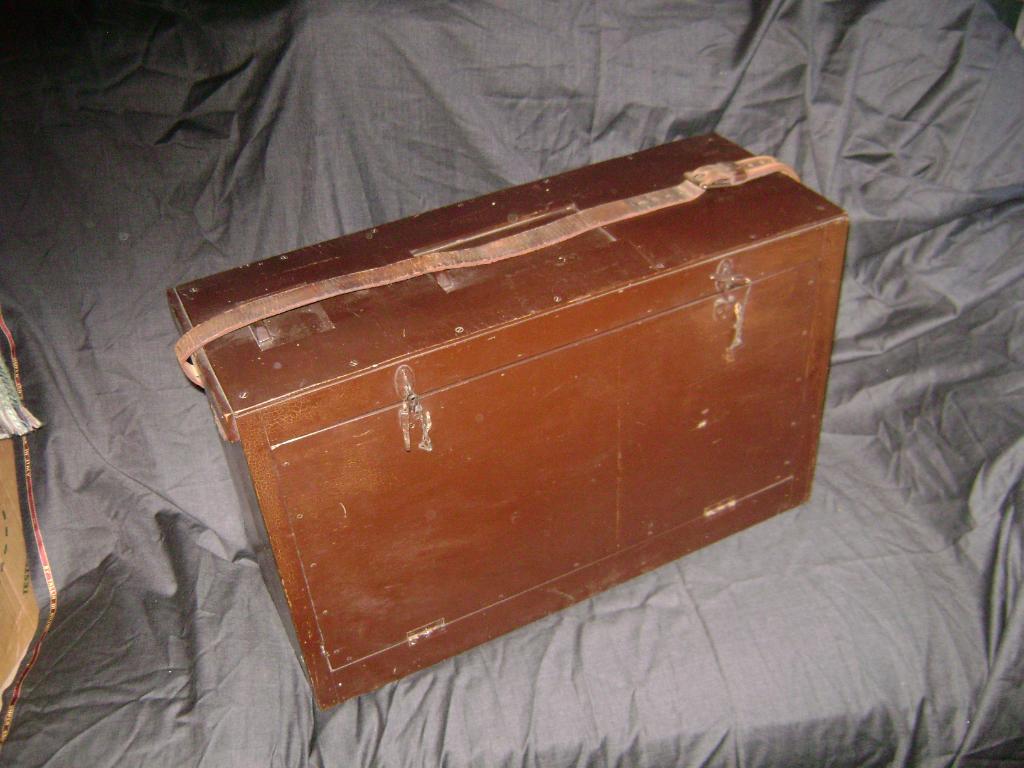
This appeared on eBay. altho' v. professional-looking, it does not seem to have been an official or commercial product, just the fruits of a someone deciding to do it and do it well.